Call for expert help (888) 724-8222

Jewelry Education and Advice

  • Made in the USA?

    You see the label all the time. Or perhaps you see it less frequently than you remember. But what does “Made in the USA” really mean when it comes to your jewelry purchase? What if your necklace is made in the US but the gems were imported from India (as in the case below)?

    These latest rulings will give you a clearer idea (hopefully) on the real meaning of the label:

    To illustrate the point, consider two example cases (loosely based on actual inquiries) addressed by the Jewelers Vigilance Committee (JVC) below.

    Two inquiries on origin

    In the first inquiry, a manufacturer’s representative asked the JVC if the company could advertise a white gold sapphire necklace produced in New England as “Made in the USA.” The sapphires for the necklace were cut, polished and imported as loose stones from India, but the findings and chain were from a U.S. source.

    The second inquiry involved finished rings that were imported from Thailand, checked for quality control at their U.S. destination, then boxed and shipped to retail stores. The wholesaler asked if he was required to provide “country of origin” information on the rings by marking or other means.

    Before you read about the outcome, it’s important to understand a little bit more about the prerequisites of a “Made in the USA” claim:

    First, for a product to qualify as “all or virtually all” made in the United States, the final assembly must take place in this country. To justify a “Made in the USA” claim if foreign articles are used in the manufacturing process, they must be substantially transformed in the United States, resulting in a new article of commerce that has a new use.

    Even if the article is substantially transformed here, if the resulting product is then assembled or processed further, outside the United States, the FTC will not consider that product to be one that is “Made in the USA.”

    So what happened in the cases mentioned above?

    In the first matter, regarding the necklace, the imported material–gemstones–will be combined with domestically sourced materials to make a necklace. While the final manufacturing process will take place in this country, the gemstones were cut and polished in India. For that reason, a qualified origin claim, such as “Made in the USA of U.S. and imported material” is appropriate.  Had the stones been sourced from India in rough form, then “substantially transformed” here by cutting and polishing, a “Made in the USA” claim for the bracelet would more likely meet FTC standards.

    As to the second inquiry concerning whether the Thai-made rings need origin markings, the one-word answer is “yes.” The imported rings must be marked, or tagged, as “Made in Thailand” to comply with U.S. Customs law.

    The JVC provided the inquiring jewelers with information about the relevant law and guidance as to country-of-origin descriptions for their products.

    Joseph Schubach Jewelers has taken “Made in USA” seriously for three generations. Nearly 100% of our jewelry has been produced right here in the states.

  • Imitation Jewelry – On Exhibit

    You’ve heard the expression – all this glitters is not gold. Nowhere is this more true than this latest exhibit in London, showcasing some of the best of the best in fake jewelry throughout history:

    “Brilliant Impressions: Antique Paste & Other Jewelry,” from June 15 to June 29 at S.J. Phillips, an antiques and silver dealer in London, is a charming, slyly subversive exhibition of 146 pieces of paste, “Vauxhall glass” and semiprecious jewels that tell the flip side of the story: How women with more style than means adorned themselves in the 17th, 18th and 19th centuries.

    “Each of these pieces that has survived is by no means run-of-the-mill,” said Diana Scarisbrick, a world-renowned jewelry historian who wrote the exhibition’s catalogue — to which Anna Wintour, editor in chief of American Vogue, provided a foreword.

    “The majority of the pieces are from the 18th century, a very high point in jewelry design, and the pieces are set the same as you’d find with beautiful diamonds,” Mrs. Scarisbrick said.

    Mostly sourced from an anonymous English collector, the false jewels in the exhibition attest to a tradition of craftsmanship and beauty to rival that of the genuine jewels from which they took their inspiration. They offer a powerful testament to the timelessness of certain styles of adornment, in particular, those that offer substantial looks at modest prices.

    Many of the pieces in the exhibition would be indistinguishable from today’s statement jewels, including a Carmen Miranda-esque pair of girandole pink and white paste earrings that date to the early 18th century, and a dramatic bib necklace of bullet-shaped beads composed of French jet, the black glass version of the organic gem that once littered the shores of Whitby, in north-eastern England.

    At their best, the pieces in the show feel pregnant with history, as with a late 18th century aigrette, or plume-like ornament, composed of chrysoberyl and tawny topaz discovered during Portugal’s mid-century foray into the mineral-rich Brazilian interior. At £20,000, or about $29,000, the aigrette, designed as a headdress decoration, is the exhibition’s most expensive piece. The oldest is a cluster pendant of rose-cut rock crystal dating to 1670.

    “It’s the first exhibition of its type and quality that’s been done,” said Francis Norton, a director of S.J. Phillips.

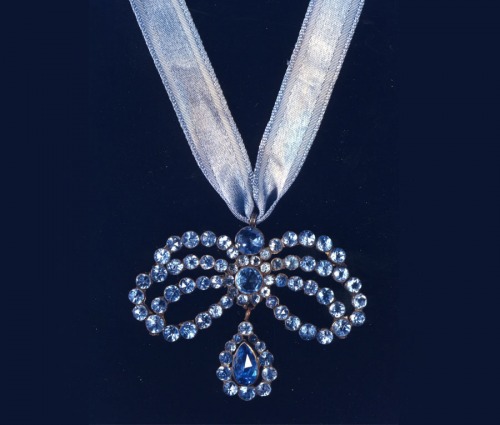
    17th century blue paste bow pendant from Kunsthandel Inez Stodel

    Source: New York Times

  • More on Selling Gold – Buyer Beware

    We’ve discussed the gold selling trend a few times in the last few months. But trends, in their usual fashion, are always changing. Here’s a recent article that details some pertinent information regarding selling gold. Remember, forewarned is forearmed. With our 100-year-old business, we understand buying and selling gold in all its complexities and all economical climates. Contact us directly if you’re thinking of selling your gold.

    With the price of gold near record highs, many are selling their gold chains and broken pocket watches at Tupperware-style parties or by mail to outfits like Super Bowl advertiser Cash4Gold.

    That could be a sign of the times – people are desperate for cash – or a sign that gold has more room to run.

    “Bubbles never blow up without the American investor class being overexposed to the item that’s in the bubble,” says Nick Zaharias, a consultant to hedge funds who put 30 percent of his family’s assets in gold. If gold were near a peak, people would be buying, not selling gold at house parties and hotel rooms, he says.

    If you want to cash in, here are some ways to avoid the Golden Fleece.

    Know the price. Gold is bought and sold at some percentage above or below the spot price, which changes constantly and can be found at sites such as Kitco.com or Coininfo.com. The more gold you sell, the better price you generally get. The price you see advertised might be what the dealer is paying for larger quantities, so be sure to ask.

    Standard gold coins such as the American Golden Eagle, South African Krugerrand or Canadian Maple Leaf contain 1 ounce of gold and generally have no “collectible” value beyond their gold content, but check with a reputable coin dealer to be sure.

    Robert Mish, of Mish International Monetary Inc. in Menlo Park, says he pays about 1 percent over the spot price for one or two such coins or 2 percent above spot “for reasonable volumes.”

    With jewelry, don’t expect to get what you paid. “The retail markup is substantial, and a lot of the value is in the design and craftsmanship,” says Morningstar analyst Paul Justice. “If you melt it down, you will lose a lot of the value.”

    Gold dealers generally won’t pay you for stones, so remove them before you weigh or sell your jewelry.

    Gold that is 24-karat is considered pure, 18-karat is roughly 75 percent gold, and 14-karat is about 58 percent gold. In other words, one ounce of 14-karat gold contains about 0.58 ounce of gold. You can estimate the value of gold using the calculator at gold.yabz.com/jewelry.htm.

    Just because gold is stamped 14- or 18-karat doesn’t mean it’s real gold. There are various tests to see if gold is real. One hint: Pure gold is not magnetic. Check with a reputable jeweler to make sure.

    — Shop around: “Usually you are better off dealing with an established brick-and-mortar place rather than companies that spend three or four days in a hotel room and disappear.

    The established person is dependent on return customers,” says David Lazier, assistant director of the California Department of Food and Agriculture’s division of measurement standards, which enforces the state’s weights and measures laws.

    In undercover sales, “We found a wide difference between what Company A and Company B are willing to pay. Sometimes you can say ‘I think it’s worth more’ and they will adjust the price,” Lazier adds.

    Last summer Consumer Reports sold identical 18-karat gold chains and pendants to three mail-order outfits offering cash for gold and to pawn shops and jewelry stores in three states. “The cash-for-gold companies paid 11 to 29 percent of the day’s market price for gold; the other venues, about 35 to 70 percent,” it reported.

  • And the Winner is…

    (above) Sevan Bicakci, who presented this ring featuring diamonds set against darkened gold, was among the Couture 2010 designers that showed a flair for darkened metal designs mixed with diamonds.


    Whenever we custom design a piece for you, whether its moissanite or mined diamonds, gold or platinum, simple or ornate, we consider it couture. It’s couture for you!

    In the jewelry business, the Couture community celebrated the best of the best in design at the Couture Design Awards held in the Encore Ballroom on Saturday night.

    After spending the first few days of the show perusing vitrines filled with jewelry and timepieces submitted to the competition, Couture retailers and exhibitors placed their votes for their favorite pieces in 10 categories, while jewelry editors selected their own designer favorite—Arman Sarkisyan—in the “Editor’s Choice” category.

    In the Timepieces/Watches category, Erica Courtney snagged first place, with Gergé Swiss in second and Fendi in third. IsabelleFa came in first in the Platinum category, followed by Henrich & Denzel.

    Best in Bridal went to Kamofie, with Katharine James in second and Mark Patterson in third.

    In the Diamond category, Mattia Cielo came in tops, followed by Moritz Glik and Hulchi Belluni. The Diamond 20+ winner was La Reina, followed by Gebrüder Schaffrath and Nam Cho. Arunashi won for best in Colored Gems, with Federica in second and Kara Ross in third.

    Best in Colored Gems 20K+ went to Damiani, followed by Monique Péan then Wendy Yue. Editor’s Choice winner Arman also took home best in Silver, followed by Armenta, and then Lois Hill and Atelier Zobel tied for third. Autore won best in Pearls, followed by Yvel in second and Yael Sonia in third.

    Finally, Heather Moore won for best in Gold, followed by Paolo Costagli and Elena Votsi.

    Winners by Category …

    TIME PIECES/ WATCHES:

    1st    Erica Courtney

    2nd    GergÉ Swiss

    3rd    Fendi

    SILVER:

    1st    Arman

    2nd    Armenta

    3rd    (tie) Lois Hill

    and Atelier Zobel

    BRIDAL:

    1st    Kamofie

    2nd    Katharine James

    3rd    Mark Patterson

    DIAMONDS:

    1st    Mattia Cielo

    2nd    Moritz Glik

    3rd    Hulchi Belluni

    DIAMONDS 20K+:

    1st    La Reina

    2nd    GebrÜder Schaffrath

    3rd    Nam Cho

    COLORED GEMSTONES:

    1st    Arunashi

    2nd    Federica

    3rd    Kara Ross

    COLORED GEMSTONES 20K+:

    1st    Damiani

    2nd    Monique PÉan

    3rd    Wendy Yue

    PEARLS:

    1st    Autore

    2nd    Yvel

    3rd    Yael Sonia

    GOLD:

    1st    Heather Moore

    2nd    Paolo Costagli

    3rd    Elena Votsi

    PLATINUM:

    1st    IsabelleFa

    2nd    Henrich & Denzel

    EDITORS’ CHOICE:

    Arman

    Source: National Jewelry Network

    Some of last year’s winners:

    A platinum and carbon fiber bracelet with black diamonds. Its particularity is the strong sensorial impact: it's surprisingly light at touch and it seems to be a Zebra at sight. The keywords of this jewel are: innovative choice of materials, creative design and exclusive luxury.

    Ring: Conch Pearl,nat.pink Diamonds. 18K pink Gold, Platinum

  • Divorce Rings – The New Next Fashion?

    Sure, it sounds a little macabre but really, why not? For some, a divorce ring represents a renewed sense of freedom or rebirth or simply, a symbol of healing. For others, it means that their marriage and its ending have been part of their life – a part for which they are proud. A transitional ring, if you will.

    According to a piece in the New York Times:

    When her divorce was nearly final three years ago, Wanda Dibben, 41, who lives outside Kansas City, Mo., asked a jeweler, George Rousis, to transform her wedding ring into a divorce ring. Ms. Dibben, who had been married 13 years, said she had been “very attached” to her wedding ring and hoped that reconfiguring it could “be kind of a buffer into my independence again and help facilitate healing.”

    Her jeweler severed the gold band and refashioned it into a ring with a gap, across which strands of silver are stitched. For Ms. Dibben, those strands represent her son, Trevor, now 14, “because although the bonds have been broken, the stitches still keep that unity together,” she said.

    Remember, rings are for everyone, not just the happily married. YOU choose what they symbolize for you and let us design it for you. Every detail can remind you or who you are and who you want to be.

  • The Sex And The City 2 Black Diamond Ring

    Source: Luxist.com

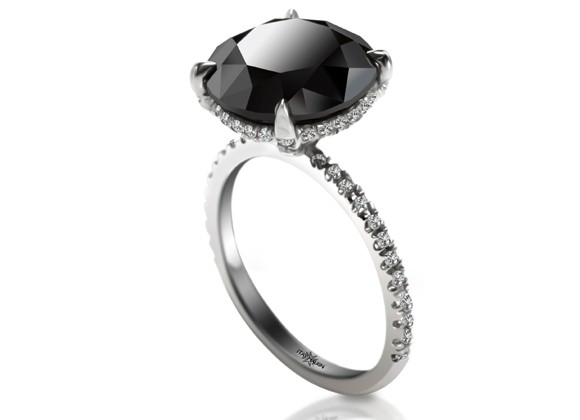
    Will you look at this ring? It’s a stunner, for sure. High degree of craftsmanship and just plain artistry. It plays a starring role in the upcoming film Sex and the City 2. Let’s hope the ring doesn’t outshine the lead actors – a very distinct possibility!

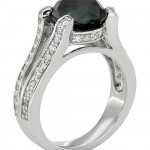
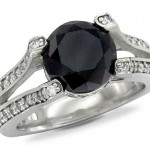
    The five-carat stone by designer Itay Malkin is set in 18 karat white gold with 80 round natural white pave diamonds equaling 0.35 carats. Malkin worked in collaboration with Sarah Jessica Parker and costume designer Patricia Field on the final design of the ring.

    The Itay Malkin ring is the only piece of jewelry from the movie that has been held to secrecy due to its importance in the plot, debuting for the first time on the big screen. Itay Malkin will produce the ring in a limited edition series for $10,000, each ring stamped with the limited edition serial number and certificate.

    Guess what? You don’t have to be Sarah Jessica Parker to wear a ring of this amazing quality. If a $10,000 ring isn’t quite in your budget, we can create a beautiful replica of this ring for a fraction of the cost, down to the black diamond.

    Here’s just one our custom design pieces. Look similar?:

    Take a e-stroll through our custom design page so you can see the detailed artistry we put into our work. We’ll make you a star, guaranteed!

  • Defective Diamonds Making a Difference

    Looks like moissanite is fast becoming something other a spectacular diamond alternative for jewelry. This piece explains how moissanite is allowing from strides in science and technology because of its affordability and strength in characteristics:

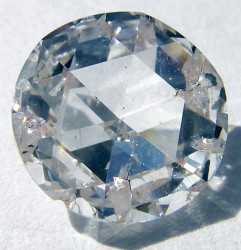
    A synthetic diamond, pictured above, may be produced with certain flaws in order to act as quantum bits for experiments in computing.

    UCSB quantum specialists recently published a paper in the Proceedings of the National Academy of Science with the results of their latest studies in diamond quantum mechanics. According to their findings, the defects found in diamond crystals may lead to the production of a quantum computer.Chris G. Van de Walle, professor of materials at UCSB, said carbon atoms in a diamond crystal are arranged in what is known as a “regular array.” Defects in this array — like missing atoms or impurities — give the diamonds their certain qualities, such as coloration. Van de Walle noted, for example, the famous blue hue of the Hope Diamond, and said such qualifying defects have been known by scientists for years.

    “Such defects in diamond have been studied for many decades,” Van de Walle said. “It is only within the past few years, however, that the applications for quantum information processing have been realized, and the group of professor [David] Awschalom has been at the forefront of this research.”

    UCSB professor David Awschalom heads the group of researchers involved in the diamond study and corroborated with Van de Walle to take steps in rendering the defective studs useful.

    “I myself had been doing research on defects in semiconductors, mostly aimed at suppressing or eliminating ‘bad defects’, because they lead to the failure of devices,” Van de Walle said.  “Professor Awschalom knew of this expertise, and suggested we would collaborate and apply our knowledge about defects for the creative purpose of designing ‘good’ defects, that are useful for quantum information processing.”

    Van de Walle said scientists can use the quantum-mechanical properties of an electron that can be bound to the defective diamond to act as quantum bits or as he called them “qubits.” This, he said, far exceeds the zeros and ones which form the language, or “binary logic”, of current computers.

    “Quantum computing uses qubits that are continuously variable between zero and one, and hence offer infinitely more possibilities to be manipulated and combined with other qubits to produce a desired computational result,” Van de Walle said.

    Van de Walle said the quantum computers, which would store and manipulate information in the form of quibits, enable completely new algorithms and applications in computing. According to Van de Walle, cryptography would evolve in more secure ways, greatly benefiting military and banking systems. Van de Walle said quantum algorithms can also offer tremendous speed improvements for searching through large amounts of data, or solving problems in physics or chemistry.

    However, as any groom-to-be knows, a diamond costs a pretty penny.

    “The centers in diamond perform very well as qubits, but diamond is an expensive and difficult material to work with,” Van de Walle said. “For instance, it is the hardest material known, which makes it very hard to cut or process.”

    As revealed in their recent PNAS publication, the group primarily focuses on identifying defects in materials which have properties similar to diamonds, but far less expensive.

    “Our systematic, exploratory research in this area is what we refer to as a ‘road map,’” Van de Walle said.

    The team, Van de Walle said, has taken interest in materials such as silicon carbide, known more commonly by jewelers as “moissanite.” Aluminum nitride is another material, Van de Walle said, with a lot of potential, since it is already used to fabricate light-emitting diodes and transistors.

    Van de Walle said he and his team hold high hopes for their project, and hope the “road map” will lead them to a fruitful destination.

    “To come up with a new type of ‘defect’ that will be as good as, or even better than, the defects in diamond,” Van de Walle said. “That would be an important step to the practical realization of a quantum computer.”

    Source: Daily Nexus

  • Fashion Week Highlights – Everyone’s a Model

    Everybody is a model during Fashion Week. Of course, you have your runway models but everyone in attendance, such as celebrities, are also fodder for the tabloids and examples of upcoming trends.

    According to expert Carly Wickel:

    Cross pendants were a common theme at London Fashion Week, with cross styles varying from traditional to contemporary. Chunky necklaces, wide bracelets and large cocktail rings continued to be popular.

    Below is a glimpse of Fashion Week at the last London Fashion Week:

    Kate Moss wore a modest station necklace and a pair of diamond earrings to the Unique Fashion Show during London Fashion Week.

    Mary-Kate Olsen, wearing an ornate cocktail ring on her index finger. Her ring finger holds a narrow style with curved extensions that flow over adjacent fingers.
    Jennifer Saunders, wearing a turquoise bracelet and a couple of earthy-looking beaded necklaces. Her daughter wore pretty cocktail rings and slipped on a wide, black bracelet with (what appears to be) turquoise trim.
    Liv Tyler wore an extra wide black cuff bracelet to the Burberry show. Emma Watson kept it simple, wearing a couple of classic rings.
    Estelle wore gold drop-hoop earrings to the Pringle of Scotland fashion show.
    Model and singer Agyness Deyn, wearing an oversize cocktail ring and a cross pendant on a chunky chain.

  • Jewels still Holding their own at Auction

    Auctions seem to exist in a special time and place, where decadence and high bids still reign, despite a daunting economy. According to one expert:

    “Gems and jewels have been doing brilliantly at auction for months, as if bidders had never been told that there is a recession,” Souren Melikian writes.

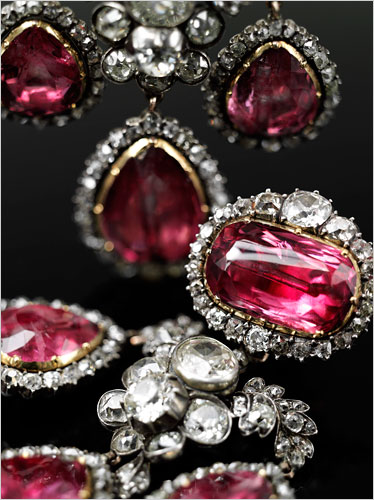
    (above) A late 18th-century pair of ear clips with spinels and diamonds, cataloged as “the property of a German Princely and Liechtenstein Ruling Family,” almost quadrupled the high estimate at $105,000 at Sotheby’s Geneva auction.

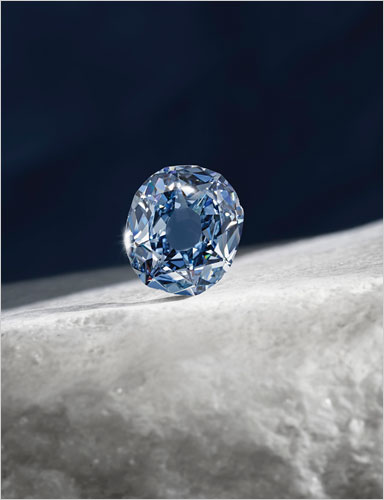
    (above) On Dec. 10, when the mood in London was at an all-time low, Christie’s sold the most expensive jewel ever. The 35.56-carat blue diamond rose to $24.31 million, or to be strictly accurate, £16.39 million, to Laurence Graff of London.

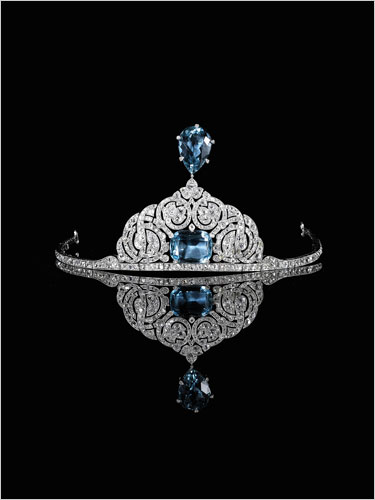
    (above) Where aristocratic provenance could be established, jewels soared sky-high. A diadem and necklace made by Cartier in 1912 for Olga Princess Paley, Countess of Hohenfelsen, both doubled their high estimates. The diadem (described as an “aigrette tiara”) set with rose-cut diamonds and two aquamarines, brought $512,014.

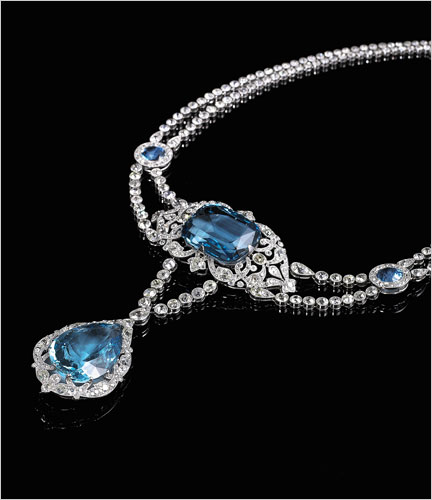
    (above) The necklace, designed in the same heavily ornate style, cost an equally breathtaking $392,700.
    (above) At Christie’s late spring London sale of jewelry on June 10, signed jewels set with good quality stones sold like hot cakes regardless of style or period.

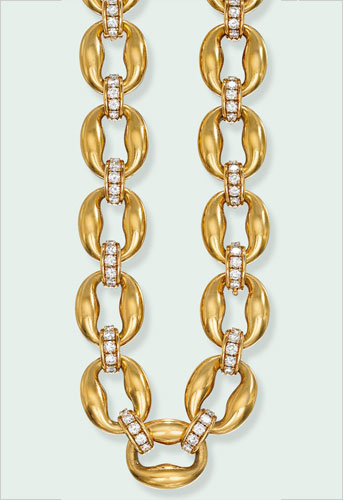
    A necklace made from oval gold links joined by diamond-set clasps and signed Cartier Paris excited bidders, who sent it climbing to $42,750, more than triple the estimate.

    Photo: Sotheby’s

    Source: The New York Times

  • Maharaja & The Splendor of India’s Royal Court

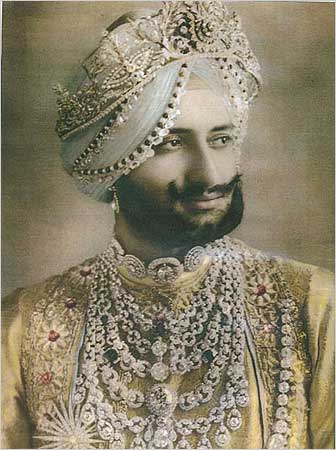
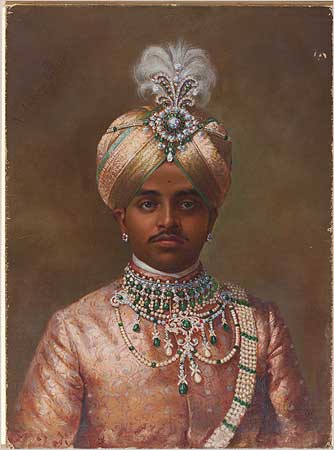
    Though the London exhibit is officially over, the photographs live on! The exhibition, “Maharaja: The Splendour of India’s Royal Courts,” which took place at the Victoria and Albert Museum in London several months ago, focused on the “the colonial years when the Indian princes, deprived by the British of their absolute rule, could concentrate on the decorative things in life.”

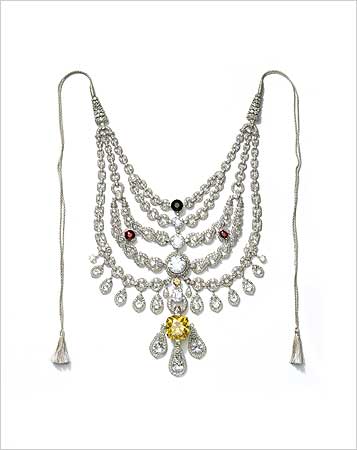
    Pictured above is the Maharaja of Patiala, wearing a diamond and platinum parade necklace created by Cartier in 1928.

    Pictured above is the Maharaja Sir Sri Krishnaraja Widiyar IV Bahadur of Mysore, 1906, by K Keshavayya.

    The jewels in the exhibition are the most poignant not just because in some cases, like the mighty Cartier Patiala necklace (pictured above), the gems that were sold to keep impoverished princes afloat have been replaced with substitute stones. Its because the show closes an era when the male peacock finally folded its wings.

    Photo: N. Welsh-Cartier

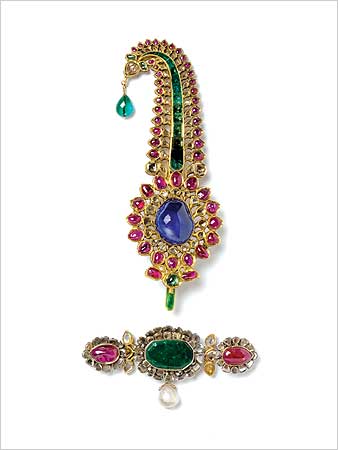
    Pictured above is the Watson Turban Jewels from mid-18th Century. A replica of this jewel is on sale in the Victoria and Albert museum shop.