Quick and Easy Jewelry Tips
I found this article to contain some easy tips on purchasing costume jewelry (it’s not all created equal!) and jewelry/fashion matching.
Joe
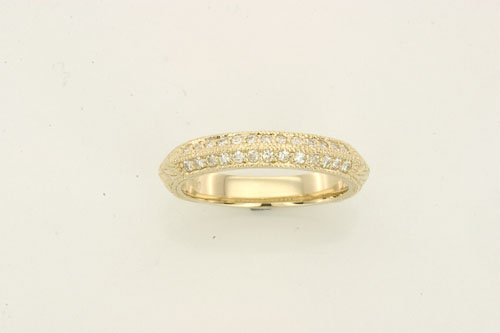
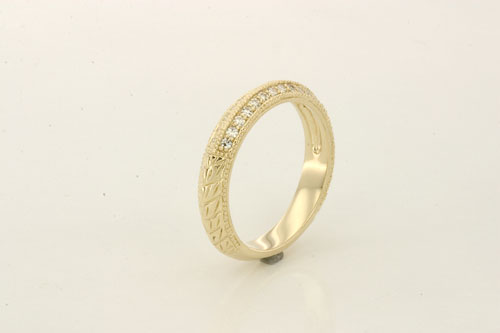
Just wanted to let you know that as I am typing this I am wearing the ring of my dreams. It came in today and all the girls at work oooed and ahhhed over it. It is amazing. One of a kind and absolutely gorgeous. Thank you so much for being so professional, knowledgeable and courteous. I will definitely be in contact with you soon to get Ryan’s wedding band.
Thanks again you and your company are an absolute pleasure!
Dagni
It seemed like only yesterday we were watching grow up in the Oval Office. Now, she’s grown up and marrying a college beau.
Chelsea Clinton and Marc Mezvinsky were married in an interfaith ceremony on July 31, 2010, at the Astor Courts Estate in Rhinebeck, New York. The estate was built by John Jacob Astor IV in the early years of the twentieth century, and sits on the Hudson River, a couple of hours north of New York City.Chelsea’s wedding jewelry included diamond earrings — each earring was made from two clusters of diamonds set to resemble small flowers. Her diamond bracelet repeated a single version of the floral setting.
Chelsea Clinton’s engagement ring is partially obscured by her bouquet, but the ring appears to be fashioned from a princess, emerald or Asscher cut diamond set in platinum (About Square & Rectangular Diamonds)
Chelsea’s strapless silk wedding gown was designed by Vera Wang, one of the couple’s 500 wedding guests. Chelsea’s mother, Secretary of State Hillary Clinton, wore a gown by Oscar de la Renta.
The floral appearance of Chelsea Clinton’s diamond earrings was repeated in the design of her diamond “tennis” bracelet.
Marc Mezvinsky, U.S. Secretary of State Hillary Clinton, Chelsea Clinton and former U.S. President Bill Clinton pose during the wedding of Chelsea Clinton and Marc Mezvinsky at the Astor Courts Estate on July 31, 2010 in Rhinebeck, New York.
Photo by Barbara Kinney via Getty Images
source: About.com – Jewelery and Accessories
We just had to show you a picture of this beauty. It was a recent winner at the recent JCK Las Vegas 2010.
According to one of JCK’s correspondents:
The 60+ Carat Yellow
Sure, there were plenty of diamonds strewn around the Venetian, but only one reached jawbreaker proportions. Amir Goldfiner, owner of Rahaminov Diamonds in Los Angeles, proudly presented his diamond—a radiant-cut, 60-plus ct. fancy vivid yellow—for the first time at JCK Las Vegas.
“A stone like that is crazy,” he says.
The rough responsible for the rock weighed several hundred carats; one of Goldfiner’s cutters spent nearly a year whittling down the original mass to its current size and shape. (The stone is now set in an 18k gold ring.)
Yet Goldfiner is reluctant to divulge much else, like grade or exact weight.
“I want to maintain the mystique,” he tells JCK, alluding to a possible auction sale. “There are very few stones like it in the world.”
And the price for that kind of ice? If you have to ask… —Jennifer Heebner
We’re here to tell you that a piece like this can be yours – and no, you don’t have to be drippingly wealthy. Gemesis is a magnificent fancy colored gem that will knock your socks off. Consider a piece like this for our upcoming custom design contest (details soon!)
just got the ring. LOVE IT! I love baguettes and this looks good with the ring I have already! I will be back when I can afford more. I’d love a pair of stud earrings also. Thanks!!
Have a great day! D
We know how much you love learning at Joe’s blog. And trust me, we have a lot of information to share! Today, we’re going to impart to you a little history lesson on earrings. Now sit back – you may learn something. And thanks to AnnieSherman.com for the great info:
Did you know earrings originated in the Middle East? The oldest earrings were unearthed at the royal graves in Iraq!
In the Renaissance era, earrings were not popular. Women wore wigs, elaborate hairstyles and high collared dresses obscuring the ears. It was not until the 17th century when women wore their hair back that earrings were back in fashion. In the early 18th century, women wore bonnets with wide ribbons covering the ears and chins. Once again earrings became obsolete. In late 18th century, however, hair went back up and earrings were popular again!
In the early 20th century, piercing of the ears was considered uncivilized and a screw back type of fitting was invented so that ear piercing was no longer necessary. The beginning of emancipation for women! Around 1930’s, clip-ons were invented and then screw-ons. Both styles were widely used for earrings for the next 40 years. Since then, earrings have indeed been revolutionized. Earrings are fun, lots of movements, made of all shapes, sizes, materials and stones and are worn day and night!
Beginning the 70’s, ear piercing became the fad. Most contemporary earrings are for pierced ears nowadays. For those who don’t like poking holes in their ears (like me), thank goodness that vintage clip-on earrings are still around!
Here’s a custom jewelry project with a long history. Christine and I have been friends since grade school. We attended Tavan Elementary, Ingleside Middle and Arcadia High schools together. Christine’s parents were customers of my father’s and for Christine’s high school graduation, her parents had a gold and diamond initial pendant made. Now, a “few” years later it’s Christine’s daughter Catherine who is graduating.
So Christine contacted me several weeks before the big day to talk about carrying on the tradition. Her idea was to do something a little more updated; have the piece made in white gold rather than yellow gold and to update the type style somewhat. In addition, she wanted to make it even more personal and special by incorporating diamonds from her collection along with diamonds from her sister, Daphne’s collection (Daphne also received a diamond initial for her high school graduation). The results are below. Click on the images to see larger versions.
Oh, I’m sure you’ve been there. Ten minutes to get ready and half of it is spent on trying to get on your necklace. You ask for some help and even your loved one has trouble! Soon, you find yourself not wearing said necklace as often because it’s just too much of a hassle.
As Terri Rocker, fashion expert, puts it:
“The best necklace clasps are easy to fasten, stay secured, match the style of the necklace, and endure the wear and tear of being repeatedly fastened and unfastened.”
Reminder when you are thinking of purchasing jewelry, consider the clasp! It could make or break your wearing experience:
Spring Ring and Lobster Claw
- Operate a spring ring or lobster claw clasp by lifting the tiny lever that compresses the spring to release the clasp. Quite secure, both of these clasps are popular, with lobster claws usually being easier to manipulate.
Hook Clasp
- Fish hook, S-hook and hook-and-eye clasps secure necklaces using hooks. While easy to fasten, these are not very secure and may slip out.
Magnetic Clasp
- Magnetic clasps use magnets to secure the necklace. Most magnetic clasps are best suited to very lightweight necklaces, as they easily come apart.
Barrel Clasp
- Barrel clasps are barrel-shaped screws that require some dexterity to twist and untwist. The larger ones are quite secure, although they are prone to looking bulky.
Toggle Clasp
- The toggle clasp is also known as the bar-and-ring clasp. With a long bar on one end that fits into a wide ring and then “locks” into position, the toggle clasp is one of the easiest to fasten for arthritic hands.
Box Clasp
- An elegant-looking clasp that often uses a filigree design, the box clasp has been known to come undone by accident. Open a box clasp by pushing the lever, and close it by clicking it into place.
Multi-Strand Clasp
- A multi-strand clasp may have hook, slide locking or box clasp fasteners. Multi-strand clasps come with 2 or more loops per side to secure multi-strand necklaces.
Toggle Clasp
Style 8963GM
1/3ct Princess cut solitaire diamond pendant set diagonaly, hanging from a black rubber cord. Available in fancy yellow, orange, pink and blue cultured diamonds.
Metal: 14kt White Gold
Stone size: 1/3ct
Colored gemstones like Gemesis can add real pizazz to your wardrobe. They are eye-catching and often, more affordable than diamonds. But just as buying diamonds requires some basic knowledge, so does the purchase of colored gemstones. Here’s a few pointers from the Better Business Bureau:
Many new stone treatments have been developed to improve the appearance and durability of gemstones. However, a treatment may lower the gem’s value and may require special care to retain the gem’s appearance.
Laboratory-created (synthetic) stones are identical to natural stones but do not have their rarity and cost; thus, laboratory-created stones are less expensive than naturally mined stones.
In contrast, imitation or “assembled” stones resemble natural stones in appearance, but may be glass, plastic or other less valuable stones.
Follow these tips:
- Ask whether the gemstone is natural, synthetic or imitation.
- Ask whether the gemstone was treated in any way.
- Learn to use a jeweler’s loupe (small magnifier) to see inside the stone to check if it is chipped or damaged in any way; ask the salesperson to educate you about the quality of the gemstone.
- Be sure you get everything in writing. A sales receipt or appraisal listing the quality of the gemstone is considered a contract and is your only means of proving what you have been told.
- Read all warranties and guarantees before buying the jewelry.
- Ask for a certificate of replacement cost or appraisal listing the special qualities of your gemstone to accompany your receipt.
- Ask about the cleaning and care of the gemstone.
Learning how to use a jeweler’s loupe is a great suggestion. We’re more than happy to show you how. Stop by our showroom in Scottsdale, Arizona. We’d love to show you around.
(above) Jewelry professionals use a magnifier, also called a loupe (pronounced loop), to inspect gemstones and other jewelry.