Call for expert help (888) 724-8222

General Jewelry Info

  • Jewelry Maitenance – Do’s and Don’ts

    Buying your jewelry is only half the battle. Maintaining it so it looks great for years takes a little know how. Here’s  what one expert has to say:
    1 Don’t wash your jewelry with toothpaste.

    In the field of jewelry there’s a belief that washing the jewelry with toothpaste can make it glossy. Actually, it’s harmful to do so. Toothpaste contains superfine grinding material whose hardness is up to 6~7 degree, almost as high as crystal. Using toothpaste will destroy the surface of jewelries whose hardness is lower than that of crystal, especially pearl, gold. The best solution should be diluted neutral surfactants (such as salad, baby shampoo).

    2 Don’t touch frequently.

    If you touch it hourly, it will affect the glossiness and brightness of jewelry. The human body continues discharge sweat and oil. The oil on the fingers will leave on the jewelry’s surface that it will reduce its glossiness and brightness, especially the diamond, which belongs to pro oily gems, whose surface gets oil easily.

    3 Don’t wash jewelry with tap water

    Tap water has fixed content of chlorine (C1), which damages the surface of the pearl and weaken its luster. The proper way should be washing it with distilled water.

    4 Let your jewelry rest.

    Change your jewelry according to situations. And at least put it away while washing your hands! Some soaps contain different degree of alkaline substances which damages jewelry potentially.

    5 Be careful using a ultrasonic cleaner

    The ultrasonic cleaner has good effects on cleaning gold, especially cleaning gaps. However, the ultrasonic cleaner is not adaptive to all kinds of jewelries. For example, emerald and pearl – their structures would be destroyed when cleaning in the ultrasonic cleaner.

    6 Examine your jewelry periodically

    Remember to examine your precious jewelry carefully every once in a while. It is very important to check out whether your diamond is fixed tightly or not. If it becomes flexible, take it to a professional jewelry service.

    Monica is a freelance writer who has written thousands of articles on various niches. She likes to share her knowledge with her readers and provide them with the best information on various topics. 

    Article Source: http://EzineArticles.com/?expert=Monica_Mo

  • How to NOT Lose your Cool, or your Earrings

    Your heart races. Your eyes widen. You begin a mad search, all the while saying, “Oh no, oh no!” Losing jewelry is stressful and upsetting. That’s because jewelry is such a personal item – losing it can feel like losing a part of ourselves.

    Here’s a few tips on how to protect yourself from the commonly lost earring:

    1) EASY No-Lose Earrings

    The best style of earrings (that are are able to be removed but hard to lose) are leverback earrings. They are made in such a way you can’t lose them as they fasten closed. That is why Diamond Leverback Earrings are so popular. They are worth investigating when buying earrings as they look beautiful, are simple to use, and are hard to lose.

    Many dangle earrings can be converted to a leverback style at your local jeweler — but you may want to try our next tip as an inexpensive alternative.

    2) Earring Stoppers For Your Fish Hook Earrings

    Many people don’t realize that when they buy earrings and there are rubber stoppers on the back of the card, that they can use them to keep the earrings on their ears.

    If you already own fish hook earrings but didn’t keep the rubber safety stoppers (or the earrings didn’t come with safety stoppers), you can buy rubber stoppers for the back to make sure your won’t lose them. They take an extra moment to put on, but they work like magic.

    3) Easy Storage When NOT Wearing Your Earrings

    Storing earrings properly makes it much harder to lose earrings. You’ll want 2 places to store your earrings.

    One place will be in your purse so if for any reason you need to take your earrings off, you have a designated place. A second a known place should be where you live. If you only own a few pairs of earrings, you can keep them all in the same portable place. However, many of us have several pairs of earrings.

    To store earrings in your purse, I recommend one of the small silk zippered bags. A small silk pouch can easily hold any pair of earrings, look beautiful and usually be very inexpensive.

    Not being able to find your earrings in the morning, is almost the same as losing them as you can’t wear them when you want. So make sure the place at home keeps your earrings neat and easy to find like an earring tree.

    So follow these earrings tips and save yourself money and time.

    Here’s a pair of leverback earrings guaranteed to stay in place:

    Style 452MR

    Classic Wire Basket Lever Back Moissanite Earrings

    Classic wire basket lever back earrings with Charles and Colvard created round Moissanite.

    Source: JewelryMall

  • Jewels in Poetry

    Today, we are going to wax poetic about jewelry. Of course, jewels and gems have been mentioned in literature and poetry since time immemorium. Why? Because jewels have a magical, mythical quality that pairs perfectly with the beauty of words. Take this lovely, lilting piece by poet Sarah Teasdale:

    If I should see your eyes again,
     I know how far their look would go --
    Back to a morning in the park
     With sapphire shadows on the snow.
    
    Or back to oak trees in the spring
     When you unloosed my hair and kissed
    The head that lay against your knees
     In the leaf shadow's amethyst.
    
    And still another shining place
     We would remember -- how the dun
    Wild mountain held us on its crest
     One diamond morning white with sun.
    
    But I will turn my eyes from you
     As women turn to put away
    The jewels they have worn at night
     And cannot wear in sober day.
    
    
  • The Gold Test

    We’ve talked about the importance of being an educated jewelery buyer many times on my blog. I figure it this way: when you know as much about the jewelry you’re buying as I do, you feel more confident in your purchase. And rightfully so: buying jewelry is a commitment. When a customer is well-informed, he or she tends to make smarter decisions that last a lifetime.

    Here’s a little lesson on the gold test:

    After choosing perfect style on your particular occasion from your favorite jewelry store, the first thing you can do is to look for karat mark, which can be found mostly on end caps (where holding lock) for necklace, bracelet and anklet.

    You will find 10kt or 417, 14kt or 585 and 18kt or 750 marking on it as well as, but not necessarily, trademark or company code and its country of origin.

    For the rings, look inside the band, you will find quality markings. These markings are mandatory and if you don’t see it, something is seriously wrong.

    Although due to some special custom made work or resizing a ring will damage marking permanently. This is where reliable jewelry store you can trust comes in. because good jewelry store will not damage or destroy these markings when necessary work or resizing.

    And secondly, if you have any doubt, let the jewelry store manager test your item right in front of you. Most jewelry store will do this for you free of charge. There’s testing kit that contains 3 small bottles of 10kt, 14kt and 18kt testing liquid (acid), in most cases, with flat stone like rectangle panel.

    They will scratch item of your choice on rectangle panel and apply appropriate liquid on it. Now observe it. What you want to see here is that scratch will remain nice and bright if item is right karat. If it is not right karat, in other words low quality, scratch will fade away and will even darken.

    And finally, a rule of thumb that you always do, let them write down what you need on the receipt such as karatage or proper return policy. This is good way to protect your hard working money as a proof of quality promise from that store.

    Partial source: Squidoo Article

    Here’s a short video on the gold testing process:

  • Knowing your Karat

    (above) 14kt yellow gold wedding band, high polished with scalloped sides and milgraining

    When it comes to karats, we have a rough idea of the definition. But really, when you’re investing in the perfect moissanite engagement ring, shouldn’t you know a little better?

    More on the Karat

    It is a common misconception that a karat is a unit of weight but it is actually a unit of measurement for the amount of gold contained within an item.

    “Karat” is also different from “carat,” which is a metric unit of weight for gemstones.

    Karat (or kt) indicates how many percentage of pure gold is alloyed with other metals like silver, copper, zinc and so on.

    Pure gold (99.99%) is generally considered to be too soft and pricey for daily enjoyment.

    For this reason, it has to be mixed with other alloys to maximize its strength and at the same time, price can be lowered down as it contains inexpensive materials to target larger consumptions.

    Only 24 karat is known as 99.99% pure gold.

    18kt gold has approximately 75% of pure gold and stamped either “18kt” or “750” for European marking standard.

    Likewise, 14kt gold has approx. 58.5% of pure gold and stamped “14kt” or “585” for European marking standard.14kt gold is most commonly used in US.

    Finally, 10kt gold has approx. 41.7% of pure gold and stamped “10KT” or “417” for European marking standard.

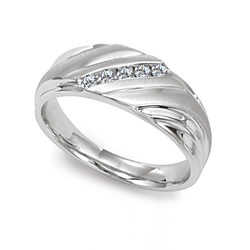
    (above) Gent's 14kt White Gold Diamond Wedding Band, diagonal design with .20ct t.w. channel set diamonds, high polished and matte finish

    Partial Source: Squidoo Article

  • Color Enhancement of Natural Diamonds

    Fancy Colored Diamonds

    You may or may not know that diamonds come in all of the colors of the rainbow, from reds and pinks to blues, greens and yellows. However, not all fancy colored diamonds get their color naturally. Below is an article explaining the color enhancement processes of natural diamonds.

    COLOR ENHANCEMENT OF NATURAL DIAMONDS
    TREATMENT OF DIAMONDS TO CHANGE THEIR COLOR HAS BEEN AROUND SINCE 1940’S. INITIALLY IT WAS DONE BY EXPOSING THEM TO RADIATION FOLLOWED BY HEAT TREATMENT (ANNEALING). THIS PROCESS IS SIMILAR TO SANITIZING FOOD PRODUCTS. THE RESULTING DIAMONDS ARE FREE OF RADIATION AND SAFE TO USE. THIS TREATMENT PRODUCES COLORS OF BLUE, YELLOW, GREEN, AND VERY RARELY PINKS AND REDS. WHILE THESE COLORS ARE PERMANENT, INDUSTRY TEST SUGGEST CAUTION BE USED FOR EXPOSURE TO TEMPERATURE ABOVE 300-400 C.
    Since the 1990’s, the color of diamonds has also been altered by HPHT process (High Pressure High Temperature). Polished or rough diamonds (natural and synthetic) are processed in the lab under very high pressures and temperatures, mimicking conditions deep in the earth where diamonds are formed. Depending on the composition of the diamond the results could be colorless as well as yellow, green, orange, and very rarely pink and blue. Colors produced by HPHT are permanent and they have the same features as a regular natural diamond.
    There are other methods of diamond treatment such as PVD (pressurized vapor deposit), a color coating scheme, and clarity enhancements such as lasering, [fracture filling] treating, or filling. Color treatment can be done on any synthetic or [natural/minded] diamond. In the US these processes are done under strict and safe conditions.    Article written by Cendico Diamond

  • Quick and Easy Jewelry Tips

    I found this article to contain some easy tips on purchasing costume jewelry (it’s not all created equal!) and jewelry/fashion matching.

    Here are some guidelines to follow when choosing a new piece of jewelry:
    1. Quality: Even inexpensive costume jewelry can be well-made. However, it can also be shoddily put together. Inspect the jewelry and look for the following:
    Are any scratches, stones missing, or chips?
    Is the setting sturdy?
    Will it bend and dent easily?
    How are beads and gems strung together? On cheap elastic or sturdy wire?
    Is it flexible?
    Are the gemstones glued into settings or set with prongs?
    2. Signed vs. Unsigned Jewelry: When purchasing costume jewelry purchasing a signed piece means it comes from a specific designer. Remember that buying designer jewelry does not guarantee better quality!
    Like clothing, sometimes designer-wear is more about the name than the quality of the item. Signed vintage pieces of jewelry can cost an arm and a leg more than unsigned pieces.
    However, you can often get the same look and excellent quality with an unsigned bracelet or pin. Check for quality, and don’t get hung up on names, whether buying a vintage piece of a new piece of jewelry.
    3. Do your research. Are you a person who cares about the latest trends? Check fashion magazines to spot what’s new in the world of accessories. If purchasing a piece online, check out the dealer or the artisan’s reputation.Are previous customers happy with the quality or the product?Did the jewelry arrive just as described?
    Also, don’t purchase jewelry that does not accommodate your lifestyle. Choose styles that will accentuate your style without compromising comfort.
    Bright jewelry stands out best against black or grey clothing. Choose rubies, turquoise, or bright-colored beads to accessorize a simple black outfit.
    Silver works best with cool-colored clothing while gold works best with warm-colored clothing. Silver looks beautiful with blues and greens while gold coordinates well with browns, reds, and yellows.
    Lower-cut shirts and dresses call for a beautiful necklace. Turtlenecks and cowl-necked sweaters look too heavy with a necklace; consider a pendant or a delicate pin instead.
    Earrings that dangle are for evenings out; at the office, earrings should never fall more than an inch below the earlobe. Studs and small hoops work best with suits and professional attire.
    A patterned outfit calls for simple jewelry. A plain gold chain and bracelet is a great way to accent a colorful dress. With jewelry, less is always more. If the piece isn’t adding anything to your outfit, save it for another day.
  • The History of Earrings

    We know how much you love learning at Joe’s blog. And  trust me, we have a lot of information to share! Today, we’re going to impart to you a little history lesson on earrings. Now sit back – you may learn something. And thanks to AnnieSherman.com for the great info:

    Did you know earrings originated in the Middle East? The oldest earrings were unearthed at the royal graves in Iraq!

    In the Renaissance era, earrings were not popular. Women wore wigs, elaborate hairstyles and high collared dresses obscuring the ears. It was not until the 17th century when women wore their hair back that earrings were back in fashion. In the early 18th century, women wore bonnets with wide ribbons covering the ears and chins. Once again earrings became obsolete. In late 18th century, however, hair went back up and earrings were popular again!

    In the early 20th century, piercing of the ears was considered uncivilized and a screw back type of fitting was invented so that ear piercing was no longer necessary. The beginning of emancipation for women! Around 1930’s, clip-ons were invented and then screw-ons. Both styles were widely used for earrings for the next 40 years. Since then, earrings have indeed been revolutionized. Earrings are fun, lots of movements, made of all shapes, sizes, materials and stones and are worn day and night!

    Beginning the 70’s, ear piercing became the fad. Most contemporary earrings are for pierced ears nowadays. For those who don’t like poking holes in their ears (like me), thank goodness that vintage clip-on earrings are still around!

    This stunningly intact 2,000-year-old gold, pearl, and emerald earring was discovered under a parking lot just outside Jerusalem's Old City.

  • Necklaces and the Dreaded Clasp

    Oh, I’m sure you’ve been there. Ten minutes to get ready and half of it is spent on trying to get on your necklace. You ask for some help and even your loved one has trouble! Soon, you find yourself not wearing said necklace as often because it’s just too much of a hassle.

    As Terri Rocker, fashion expert, puts it:

    “The best necklace clasps are easy to fasten, stay secured, match the style of the necklace, and endure the wear and tear of being repeatedly fastened and unfastened.”

    Reminder when you are thinking of purchasing jewelry, consider the clasp! It could make or break your wearing experience:

      Spring Ring and Lobster Claw

    1. Operate a spring ring or lobster claw clasp by lifting the tiny lever that compresses the spring to release the clasp. Quite secure, both of these clasps are popular, with lobster claws usually being easier to manipulate.
    2. Hook Clasp

    3. Fish hook, S-hook and hook-and-eye clasps secure necklaces using hooks. While easy to fasten, these are not very secure and may slip out.
    4. Magnetic Clasp

    5. Magnetic clasps use magnets to secure the necklace. Most magnetic clasps are best suited to very lightweight necklaces, as they easily come apart.
    6. Barrel Clasp

    7. Barrel clasps are barrel-shaped screws that require some dexterity to twist and untwist. The larger ones are quite secure, although they are prone to looking bulky.
    8. Toggle Clasp

    9. The toggle clasp is also known as the bar-and-ring clasp. With a long bar on one end that fits into a wide ring and then “locks” into position, the toggle clasp is one of the easiest to fasten for arthritic hands.
    10. Box Clasp

    11. An elegant-looking clasp that often uses a filigree design, the box clasp has been known to come undone by accident. Open a box clasp by pushing the lever, and close it by clicking it into place.
    12. Multi-Strand Clasp

    13. A multi-strand clasp may have hook, slide locking or box clasp fasteners. Multi-strand clasps come with 2 or more loops per side to secure multi-strand necklaces.

    Spring Ring Clasp

    Toggle Clasp
  • The History of the Engagement Ring

    In my end is my beginning. ~ Mary Queen of Scots

    Here at Joseph Schubach Jewelers, we consider ourselves educators of sorts. We want our customers to be as knowledgeable as possible, so their choices are sound and right. And the history of jewelry is no different; when you understand the past, you realize the power that it holds. A diamond ring is not just a diamond ring – its a symbol of love and strength that stretched back centuries:

    Since at least 5000 BC, men and women have worn rings – on their thumbs, fingers and even toes.

    Some rings have been purely decorative, seal rings and archers’ rings have had useful purposes, while a few have been thoroughly nasty specimens, harboring poison that turned a handshake into a deadly clasp.

    The earliest written reference to rings as love tokens is in the second century BC, in works by the Roman playwright Plautus.

    The practice of exchanging wedding rings, apparently common in Rome, was “Christianized” by the 4th century AD.

    An early example of an engagement ring featuring Eros, the ancient symbol of love. By the 14th century, wealthy Europeans had their wedding rings set with precious jewels, somewhat like modern engagement rings, but it was not until 1477 that the diamond engagement ring as we know it came into being.

    That year, the Hapsburg Emperor Maximilian I gave a diamond engagement ring to his fiancée, Mary of Burgundy. This first instance of a royal engagement ring fueled the European passion for diamonds, already aflame by the taste for fine jewels promoted by Mary’s father, Charles the Bold (1433–77).

    As the dukes of Burgundy controlled Europe’s major diamond–cutting centers in Antwerp and Bruges, Charles’ encouragement of wealthy Europeans to buy diamonds appears to have a commercial side.

    By the 16th century, it seemed no royal marriage was complete without a diamond ring. Mary, Queen of Scots, chose one when she married Lord Darnley in 1565 and in 1673, James II of England sent a diamond ring to Mary of Modena for their proxy wedding in 1673.

    In 1839, Prince Albert gave Queen Victoria a diamond ring as a memento of their first meeting, perhaps inadvertently setting the royal seal of approval on diamond engagement rings.

    It was during the second half of the 19th century that the practice of giving two rings for the bride became firmly established.

    Prince Philip carried on the royal diamond tradition when he gave his fiancée, now Queen Elizabeth II, an engagement ring made with diamonds from the tiara of his mother, Princess Alice.

    Source: Ancient Jewelry Facts

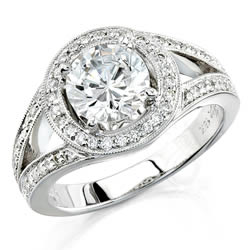
    Style 9335M

    Split Shank Milgrained Engagement Ring With Round Stones

    Split shank milgrained engagement ring with approx. 1/3ct t.w. pave’ set side stones. Fits a 7mm round center stone. (Setting only, does not include center stone)