Call for expert help (888) 724-8222

Jewelry Education and Advice

  • Celtic Jewelry Standing the Test of Time

    The amazing aspect of jewelry is its remained surprisingly unchanged over centuries and centuries. That’s not to say there isn’t a variety of jewelry – but when you look at pieces made hundreds of years ago, there’s a connective thread – a similarity or look that resonates even today.

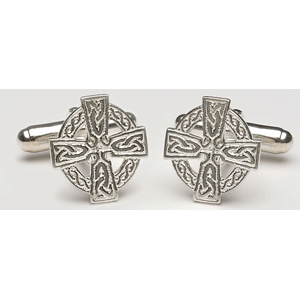
    Take the Celtic Cross:

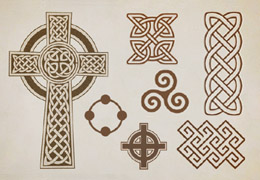
    The Celtic cross (aka “high cross,” or “sun cross”) is a familiar, and iconic motif that is associated with Celtic Christianity, although its origins are pre-Christian, dating back to the Bronze Age in the 3rd millennium BC. As a “sun cross,” the Celtic cross represents both the Solstices and equinoxes. Other interpretations say that the Celtic cross symbolizes the the four elements of air, earth, fire, and water, or perhaps the four quarters of the earth.

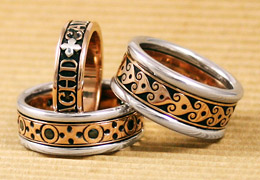
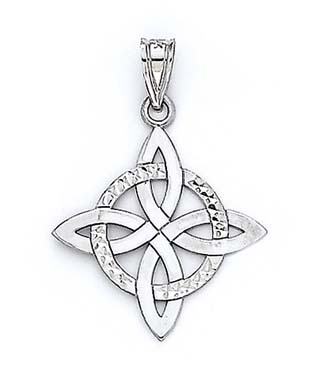
    The beauty in learning the history of jewelry is that you can create a piece using mythic symbols that span centuries. Symbols are powerful and transformative. Some say grounding or protective. Others simply like the look. Here are some sample to spur your imagination. And remember, if you want a piece rich in historical signficance and fashionably sound, we can create it with you!

    And some Celtic pieces from today:

  • When to Wear Slightly Upscale Jewelry

    It’s easy to decide on your pearls for that upcoming wedding or that simple pendant for a picnic in the park. But some events call for something in-between. This would include a work-related party or a PTA meeting or a semi-casual first date or an important family affair, like a 25th anniversary party. Times like this, it’s nice to accent a little bit more.

    Here’s what one expert has to say:

    There are those in between places you go, where slightly dressier attire might be called for. A simple dress or a modern looking pant suit is the likely choices for things like this. There is such a wide variety of mod looking jewelry available that have classy looks. Outfits like these ask for a little more than the simple little chain and pendant. The newer pieces like solid silver neck pieces with a stylish slide pendant are great for dressy casual wear. Cuff bracelets and bangles made from all sorts of metals are appropriate as well. Just do not over do your jewelry in comparison to your clothes.

    The most fun occasions to wear jewelry are those occasions when we have the opportunity to break out our nicest pieces and can wear them to the elegant places we love to go. Things like plays and fancy restraints are the perfect reason to wear our bigger diamonds, strands of beautiful pearls, and luscious colored gem stones. If you are like most of us these chances do not happen everyday, so put on your most glamorous jewelry and look like a million!

    Here’s a few samples from our gallery:

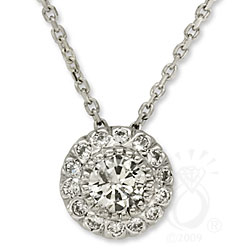
    Classic Sweetheart Pave Necklace

    Classic Sweetheart pave necklace with 1/5ct t.w. round brilliant stones set on an 18″ cable chain. Fits a 4.5mm (1/3ct diamond) round center stone. (setting only, does not include center stone).

    Style 10110

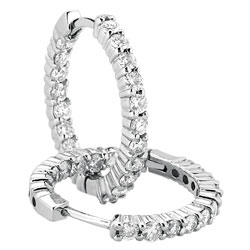
    Inside Out Hoop Earrings With Round Stones

    Prong set inside out hoop earrings set with round brilliant stones.

  • Custom Palladium Jewelry

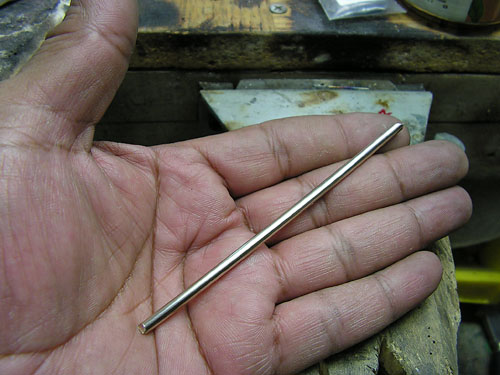
    We are in the process of hand fabricating a piece of custom jewelry – a palladium engagement ring for a client and thought we would show you how a hand fabricated piece starts out and explain a little how the process works.

    A truly hand fabricated piece of jewelry is different from a traditional lost wax/cast process. With a custom lost wax process, the wax model is carved by hand or carved with a machine (CAM). This wax is then used to directly cast in metal the final piece of jewelry. With a hand fabricated piece, we start out with a piece of metal, like the metal rod shown here. The metal is then worked (filed, hammered, shaped, etc.) by hand into the shape of the final piece. So, rather than carve a wax and cast from the wax, a hand fabricated piece is literally made entirely from hand. It is a much more difficult process to do.

    Some pieces are better off being hand fabricated than cast. For example, jewelry that has very fine scroll detail or gallery sections that require fine, intricate polishing are great candidates for hand fabrication. This piece will have very long, smooth curves, and hand fabrication will give us a smoother, more even finish when we’re through.

    We’ll try to get some pictures of this ring mid process and post to the blog.

    Looking for a platinum alternative? Try palladium (click here for additional information).

  • Jewelry – Where it all Began

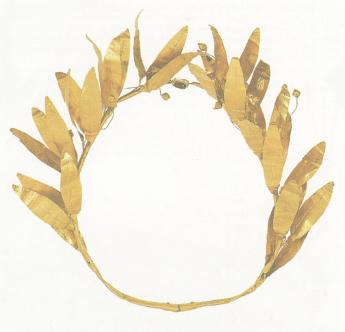
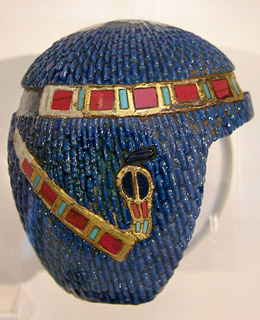
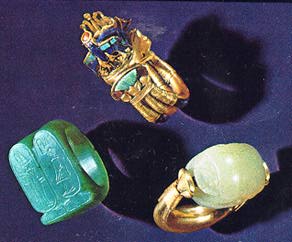
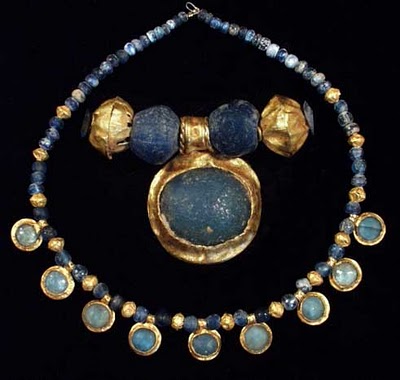
    Jewelry has existed for eons. It was used in the past not only as a form of adornment but also as a sign of status or religious affiliation or a form of protection. Egyptian jewlery, some believe, is where jewelry making became more relevant and widespread. It’s influences are still felt in jewelry today.

    According to one site:

    Many consider the period of Egyptian jewelry as the dawning period for our modern form of jewelry. It was during this time that the manufacturing of jewelry became a profession and techniques and skills evolved to create a wide variety of styles and adornments.

    Jewelry craftsman began to utilize artistic skill and an increasingly wide variety of materials. While artistic skill was valued the primary purpose of jewelry was to act as amulets and talismans. Gemstone and metal color was of greater importance than any other attribute. Gold was used extensively but this is primarily because it was readily available and very easy to work with. Many expensive gemstones we consider precious today like diamonds were very rarely used simply because they did not exhibit the color or symbolism of other gemstones.

    Egyptian beliefs stipulated that every gemstone carried certain mystical powers which would be transferred to the owner when worn as jewelry. Symbols such as the sacred Egyptian scarab also formed an important part of jewelry and were also believed to carry certain powers.

    Here are some pieces that still inspire. If you’re looking for a piece with a classic Egyptian feel, consider us. We can custom design a jewelry piece with your classic tastes specifically in mine.

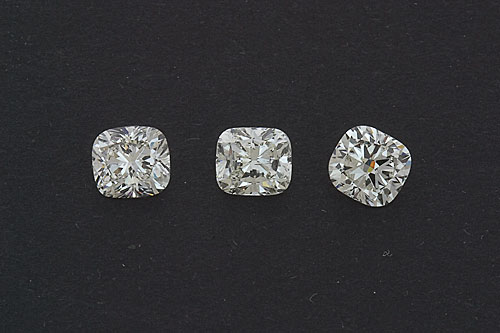
  • Three Cushion Cut Diamonds – Which one would you choose?

    un set cushion cut diamonds

    un set cushion cut diamonds

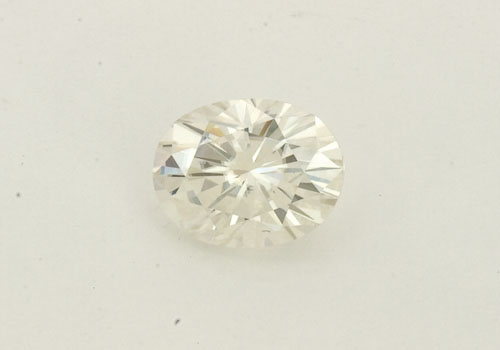
    It’s all in the make! That’s an industry term for stating the importance of a diamond’s cut, or proportions, which is what you ultimately see once the microscopes are put away and the diamond is set into a ring. This is what gives a diamond it’s ‘Wow’ factor and determines how much sparkle the diamond has.

    We are currently helping a client choose a diamond for an engagement ring. As you can see in the picture above, we have three nearly identical cushion cut diamonds with three very different proportions giving us three different looking diamonds. All three diamonds have nearly the same weight and are similar in color/clarity.

    Which do you prefer? Let us know.

  • Points on Palladium

    Last week, you learned a little about platinum and its finer points. This week, we shift the spotlight to palladium, the lesser known “little brother” to platinum. What is this wonder metal and how can it add to your jewelry wardrobe?

    According to Wikipedia:

    Palladium itself has been used as a precious metal in jewelry since 1939, as an alternative to platinum or white gold. This is due to its naturally white properties, giving it no need for rhodium plating.

    It is slightly whiter, much lighter and about 12% harder than platinum. Similar to gold, palladium can be beaten into a thin leaf form as thin as 100 nm (1/250,000 in).

    So not is it only highly durable, it’s affordable – making it quite popular during a struggling economy. According to Pierce Mattie Public Relations:

    A sure sign of its rise to fame came at the 2009 American Gem Trade Association Spectrum Awards where they announced that Palladium is finally gaining more acceptance in the designer world.  Many designers including Tenthio, Sasha Primak, and Michael Sugarman will be developing an entire palladium collection in conjunction with high-karat gold and platinum lines.

    Additionally, retailers can expect to see an increase in palladium pieces at upcoming trade shows.  Solidifying the trend, some of the most highly acclaimed names in the design world will also be adopting the metal, including Robert Lee Morris, Paul Morelli, Zoltan David, Alishan, Michael Bondanza, and Barry Kronen.

    (above) Wedding bands were in demand during the 1940s, and many were made of palladium. This diamond-set eternity band is engraved “E.A.E. & M.O’R. Oct. 20, 1943” and “Palladium – Tiffany & Co.” (see inset). Courtesy of Kurt Rothner, Excalibur, West Hollywood, CA.
     

    Here are a few other stellar examples of palladium pieces:

  • Points on Platinum

    Platinum is a bit of an elusive metal. We all have a historical understanding of gold and silver but platinum can seem like the odd man out. What is it exactly? And why would you choose platinum over other metals for a wedding band or other fine jewelry? Well, here’s a few points on platinum to ponder prior to purchase:

    All the platinum ever mined would fit in the average size living room!

    Annually, only about 133 tons of platinum are mined, compared to about 1,782 tons of gold.

    Louis XVI of France proclaimed platinum the only metal fit for royalty!

    10 tons of ore and a five month process is needed to make up one ounce of platinum.

    1a.gif (204 bytes)lthough Platinum may seem new, it is also legendary. The Ancient Egyptians and South American Incas prized it. France’s Louis XVI proclaimed it the only metal fit for royalty.

    1l.gif (181 bytes)egendary jewelers such as Cartier, Faberge and Tiffany created their timeless designs in Platinum. The world’s famous diamonds, including the Hope, Jonker I and Koh-I-Noor, are secured by the permanence of Platinum.

    1p.gif (248 bytes)latinum reached its peak of popularity in the early 1900’s, when it was the preferred metal for all fine jewelry in America. When World War II began, the U.S. government declared Platinum a strategic metal and its use in non-military applications, including jewelry, was disallowed. To appease consumers, who preferred Platinum’s white luster, white gold was substituted in Platinum’s absence.

    Fashionable

    It is very fashionable to wear Platinum with your gold jewelry. In fact, many Platinum designs combine the two metals. Platinum’s white color beautifully contrasts with yellow gold and adds versatility to your jewelry wardrobe.

    No other jewelry metal is more precious, more lasting or more appealing than platinum. Its rich white luster and understated elegance are beyond compare.  Discover why platinum is the metal of choice for today’s discriminating jewelry buyer.

    Strong

    It is the heaviest of the precious metals, weighing almost twice as much as karat gold. Its strength ideally secures diamonds and other precious gems.

    Even after many years, platinum will not wear away or wear down. For example, after many years of wear, a gold wedding band’s shank will wear down and become thinner. This is not the case with platinum.

    As with all precious metals (gold, silver, etc.), platinum can be scratched. However, with platinum, there is actually no material lost from the scratch as there is with gold. If your platinum jewelry becomes scratched, simply take it to your jeweler for a quick polish.

    Pure

    In America, platinum jewelry contains either 90% or 95% pure platinum. By comparison, 18 karat gold is 75% pure and 14 karat is 58% pure gold. Platinum will never tarnish or lose its rich white luster.

    Rare

    Ten tons of ore must be mined to produce a single ounce of platinum. It takes five months to process platinum ore into pure platinum. Only after this time can skilled hands work their creativity and craftsmanship, transforming platinum into pieces of wearable art.

    Versatile

    Platinum jewelry is as versatile as it is beautiful. The choice is yours: platinum with karat gold accents for breathtaking new versatility or, for the purist, the subtle look of all platinum.

    Whether inspired by classic or contemporary themes, platinum jewelry is perfect for any occasion under the sun, moon or stars. A quiet luxury in today’s world. A treasure to be worn.

    Source: History of Platinum

    Style 6813WB

    Platinum Comfort Fit Band With Hammer Finish And High Polished Sides

    Platinum comfort fit wedding band, hammer finished center, high polished sides, 6mm wide.


  • How to Care for your Jewelry the Right Way

    If you’ve recently invested in a fine piece of jewelry, whether its moissanite, Gemesis or natural diamonds or whether it’s platinum or gold, tending to your jewelry ensures a long, brilliant life.

    Here are some basic tips to remember to keep the sparkle in your bling!

    Diamonds

    Soak for 20 minutes in a solution of one cup warm water and 1/4 cup ammonia. Then gently scrub with a soft-bristle toothbrush, getting into the small areas between the diamond and the setting. Rinse with warm water, and lay on a tissue to dry. If your diamonds are set in platinum, this method will also clean the setting.

    Pearls

    Rub each pearl individually with a soft, clean cotton cloth dampened with a solution of two cups warm water and a few drops of a mild dishwashing liquid, like Joy. (Soaking strands of pearls can cause the string to stretch.) Let air-dry overnight.

    Silver

    Rinse in warm water and pat dry. If silver is tarnished, use a silver-polishing cloth or a jar of silver-cleaning fluid, such as Goddard’s Silver Dip (available at drugstores). (Silver cleaner won’t harm gold and platinum, but it won’t clean them, either.) For jewelry with intricate designs, use a silver-cleaning paste, which can get into small crevices. (Don’t use toothpaste or other abrasive cleaners, which will scratch.) Wipe with a clean, soft cloth.

    Turquoise

    Dip in warm water. Gently scrub with a soft toothbrush. Rinse with warm water. Let air-dry.

    Gold

    Soak for 15 minutes in a solution of two cups warm water and a few drops of a mild dishwashing liquid, like Joy. Gently scrub with a soft-bristle toothbrush. Rinse with warm water, and dry with a soft cloth.

    Source: RealSimple.com

    14kt Rose Gold Earrings Set With Pink Moissanite And White Diamonds

    Beautiful, one of a kind 14kt rose gold earrings with 1.0ct t.w. (dia equiv) Charles and Colvard created round moissanite color enhanced to spring pink, surrounded by 1/3ct t.w. white diamonds.

  • The Tennis Bracelet – A Brief History

    Is it a bracelet you wear while playing tennis for good luck? Or perhaps what an in-step fashionista wears after a game, while sipping a mint iced tea in the tennis club? Or maybe none of the above.

    The actual story is rather interesting:

    Tennis bracelets got their unusual name from an incident involving professional tennis player Chris Evert during a match in 1987. Evert had been wearing an expensive bracelet featuring an inline string of individually-set diamonds. When the clasp snapped, she asked the officials to stop the match until the jewelry could be found. Since that day, bracelets featuring an inline array of diamonds have been called tennis bracelets.

    In the jewelry world, tennis bracelets are the perfect accessory for formal occasions because of their sparkle – an “upscale” bracelet. Individual diamonds (or moissanite or Gemesis) are placed in square settings and then strung into a bracelet held together by a clasp. The settings and support wiring may be constructed from silver or other metal.

    The nice part about tennis bracelets are their comfortability. They provide “give” while wearing and glide on the wrist elegantly and smoothly.

    Here’s one of our favorite tennis bracelets:

    Style 1857M

    Bezel Set Moissanite Tennis Bracelet

    Bezel set tennis bracelet with Charles and Colvard created round moissanite, standard 7″ length.

    Available Moissanite Total Weight: 3.0ct-8.0ct

  • Gold Jewelry – A Few Facts

    Gold is one of the most versatile jewelry metals around. It never goes out of style, looks good on just about anyone and feels warm and rich to the wearer. Pure gold doesn’t react with other elements to create tarnish and while people who may have allergies when gold is combined with metals rarely have a problem with pure gold.

    Gold can be manipulated in numerous ways as well, so if you are custom designing a piece with Joseph Schubach Jewelers, you choose a metal whose varieties are infinite.

    Here are some pointers to remember about gold:

    • 24K gold is pure gold.
    • 18K gold contains 18 parts gold and 6 parts of one or more additional metals, making it 75% gold.
    • 14K gold contains 14 parts gold and 10 parts of one or more additional metals, making it 58.3% gold.
    • 12K gold contains 12 parts gold and 12 parts of one or more additional metals, making it 50% gold.
    • 10K gold contains 10 parts gold and 14 parts of one or more additional metals, making it 41.7% gold. 10K gold is the minimum karat that can be called “gold” in the United States.
    • Palladium or nickel can be added to create white gold. Adding copper produces a rose or pink tint, while silver gives gold a greenish cast.When metals are added to the gold the result is an alloy, a blended mixture. Solid gold is a term that can be used to describe an item that’s at least 10K (in the US) gold all the way through. Even though it’s a gold alloy–18K, 14K, or anything down to 10K–it can be called solid gold.

    Gold, in the Raw