Call for expert help (888) 724-8222

Jewelry Education and Advice

  • Metal Finishes – a Quick Lesson

    It’s Monday and class has officially begun. So sit down in your seat, take that baseball cap off and get that pencil out of your mouth!

    You see, at Joseph Schubach Jewelers, we feel an educated customer tends to be a happier customer. They know the right questions to ask and we have the answers at the ready.

    Today, let’s talk a little bit about metal finishes, which can make a big difference in the look of your final product:

    Metal finishes

    (above) An example of gold plated jewellery

    For platinum, gold, and silver jewellery there are many techniques to create finishes. The most common are: high-polish, satin/matte, brushed, and hammered.

    High-polished jewellery is by far the most common and gives the metal the highly-reflective and shiny look.

    Satin, or matte finish reduces the shine and reflection of the jewellery and is commonly used to accentuate gemstones such as diamonds.

    Brushed finishes give the jewellery a textured look, and are created by brushing a material (similar to sandpaper) against the metal, leaving ‘brush strokes’.

    Hammered finishes are typically created by using a soft, rounded hammer and hammering the jewellery to give it a wavy texture.

    Some jewellery is plated to give it a shiny, reflective look or to achieve a desired colour. Sterling silver jewellery may be plated with a thin layer of 0.999 fine silver (a process known as flashing) or may be plated with rhodium or gold.

    Base metal costume jewellery may also be plated with silver, gold, or rhodium for a more attractive finish.

    Source: Wikipedia

    So there you go – a lesson in finishes. Now go forth and conquer!

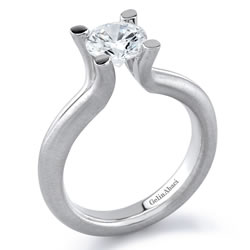
    Style 9504M

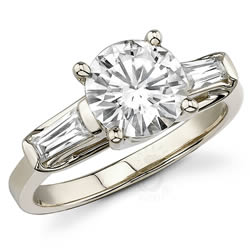
    Solitaire Tension Set Engagement Ring With A Round Moissanite And Brushed Finish

    Tension set ring with brushed finish (setting only, does not include center stone)

  • A Few Jewelry Do’s and Don’ts

    Do:

    * Wear ivory and tortoiseshell, but only if they’re fake.
    * Assemble a collection of good, basic costume jewelry:
    * Wear a pair of matching gold bangle bracelets, or a gold cuff not wider than an inch and a half.
    * Link necklaces in varying lengths.
    * Own a pair of simple gold hoop earrings, or gold button-style clip-ons.
    * Buy a two-tone watch so that you can wear it with silver or gold jewelry.
    * Keep your jewelry organized. Even egg cartons or plastic silverware trays will do.
    * Wear large earrings if you’re a large woman–you’re among the few who can carry them off.

    Don’t:

    * Wear jewelry that jingles when you walk.
    * Pierce your ears more than twice in each lobe. Never wear earrings so heavy that they stretch your lobes.
    * Mix your metals. Silver jewelry is out of the question if your jacket has
    gold buttons.
    * Wear rhinestones before 6 p.m.
    * Squeeze a large neck into a dainty choker. It just doesn’t work.

    And here’s a few additional fashion pointers:

    Don’t pull up your stockings in public.
    Do wear color near your face.
    Do soften the hard lines of a suit with a lace top underneath.
    Don’t wear sweaters so long that they make you look short.
    Do borrow your husband’s clothes.
    Don’t wear acid-washed jeans.
    Cropped pants can make you look shorter.
    Do wear a hipslip or minimizer under tight clothes.
    Do have a stash of basics on hand: T-shirts, leggings, black socks and tights.
    Patterned leggings can make legs look heavier.
    Monochromatic outfits are one of the best slimming secrets there is.
    Don’t overaccessorize.

    Sources: Masterstech

  • Eco-friendly Jewelry – Steps you can Take

    If you’re on a tight budget during this never-ending recession, remember: you don’t have to sacrifice spirit-lifting pleasures such as jewelry.

    Here are a few steps you can take that are only a jewelry box away!

    Get Rid of Old Gold:

    Your old, unused gold and platinum jewelry could be worth hundreds, even thousands of dollars – more now than ever before. Why not sell your old gold and turn it into something new and exciting!

    Joseph Schubach Jewelers will buy your old gold and platinum jewelry out right or apply it to a new purchase. It’s an easy way to get that ring you’ve had your eye on – or to get some extra cash. Contact us for details on how we can help you turn your old memories into new ones.

    Keep the Stones:

    If you’ve got fine jewelry that seems worn or out of date, or broken, you should keep the stones. Think of a jeweler as a tailor, if you need a ring redesigned, it’s a cinch. Emeralds are just like buttons that can be added to other pieces to give a whole new look.

    A good practice is buying old jewelry from swap meets, garage sales, or estate sales. Keep thinking about the type of jewelry design you would like, and just be creative to get it by combining elements from more than one piece. It’s far less costly to have the diamonds and gemstones available and just put them in a different setting, than to buy an entirely new piece.

    Develop a Relationship with your Jeweler:

    With gold being as valuable as it is, it’s important to work with a jeweler you can trust. You don’t want to end up handing in a 14k gold chain and receiving a piece with 10k gold. It’s very likely that you won’t even notice, but the piece will be worth far less.

    The same is true of diamonds in your recycled jewelry. An unscrupulous jeweler can switch gemstones on you, leaving you with a less valuable piece while he resells the one he switched.

    After 100 years in business, we can assure you that we are the most trusted jeweler we know and we pride ourselves in creating relationships that span generations. Give us a call at (888) 724-8222 and let us see how we can help you recycle your jewelry today. There may be a new gift in store for you.

    Partial Source: Abazia’s Diamonds

  • The 5 Worst Jewelry Mistakes

    You know them when you see them. You can’t help watching, like a fashion train wreck, slowly unfolding before your eyes. Jewelry mistakes can happen to the best of us. Luckily, these fashion faux pas can easily be avoided with a few tips on what not to do:

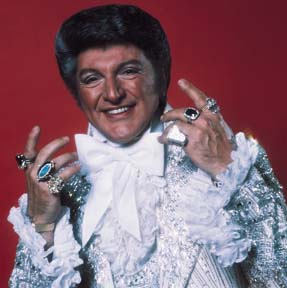
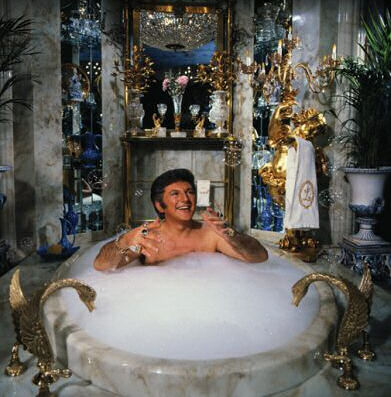
    1. Jewelry Overkill – Unless you’re Liberace, too much jewelry distracts from your outfit and ultimately from you. Often one single, well-crafted piece of jewelry is all that is needed to make a statement. This doesn’t mean there isn’t a time and place to be a little excessive. Layering bracelets can look great, for instance. But you may want to stop there!

    2. Wrong Jewelry/Clothing Combo – If you’re wearing a delicate, sheer top and an over-sized, clunky necklace, you may want to think again. Your choice of jewelry should enhance the overall tone of your outfit. A classic example of the right combo? A black cocktail dress with a string of freshwater pearls. Or that delicate, sheer top with a simple gold necklace.

    3. Wrong Jewelry/Body Type Combo – If you’re a petite gal, a large piece of jewelry can overwhelm your look and make you seem weighed down. In turn, a larger woman may seem strangled by a thin, short necklace. It’s about proportion ultimately. The same holds true with the size of your face. An elongated face type will just seem that much more drawn by long, dangling earrings.

    4. Dirty or Just Plain Old Jewelry – Vintage jewelry is one thing but tarnished jewelry or jewelry missing stones just sends an “I don’t care” message. Nowadays, it doesn’t take much to shine up a necklace or your replace stones in your grandmother’s earrings. You can do it yourself or have it done by a professional for a very reasonable price.

    5. No Jewelry at All – There is a time and place for no jewelry, don’t get me wrong – like when you’re hiking, for instance. But for the most part, jewelry is an adornment that can bring you and your outfit to life…and just make you feel good. If you’re the type of person who thinks jewelry is too much of a bother, a simple piece might be just the right choice for you, like our Keys of Love pendant necklace.

    And remember…there was only one Liberace!

  • Pricing Jewelry – What’s a Piece Really Worth?

    (above) A Clarity Enhanced Diamond - Still a Stunning Diamond but at a Fraction of the Price


    What makes one platinum wedding ring cost more than another? Why does moissanite cost much less than naturally mined diamonds but more than cubic zirconia? And why would jewelry prices change from year to year?

    Pricing jewelry is not an easy process; markets fluctuate and materials can change in availability. On top of that, the design and name of a piece of jewelry can tip the scales in one direction or the other.

    Here’s an excerpt for LuShae’s Jewelry blog that elaborates:

    People are often curious to understand why one particular piece of jewelry can be so much more expensive than another piece. The material used to construct jewelry plays a big part in determining its price. Cubic Zirconium and Stainless steel are affordable, gold and silver more expensive. Platinum is twice as expensive as 24k gold and Rhodium cost 10 time as much as platinum.

    Certain types of materials are also easier to work with than others and so the complexity, skill and cost of tools and procedures used to manufacture the jewelry also vary.

    Jewelry designed by certain jewelry artists also plays a part in determining prices. Artists release a limited range of styles and designs and some even produce unique one-off pieces. Demand for popular styles and limited number pieces results in premium prices.

    At Joseph Schubach Jewelers, we know how to price jewelry so it’s affordable as well as a stunning piece of jewelry. You don’t have to sacrifice quality for cost with us. Spend some time on our site and you’ll see!

    Moissanite - The Full Diamond Experience at a Fraction of the Price

  • 18kt yellow gold

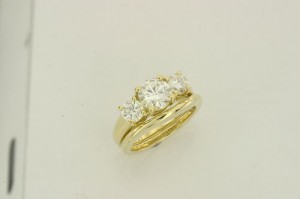
    Whenever we make a ring in 18kt yellow gold I’m reminded how beautiful the metal is. It has a very royal look to it, a color so rich that you can nearly taste it!

    Remember, you can have any ring on our site, custom made or otherwise, done in 18kt yellow gold!

    Our style #1052 with matching wedding ring

  • The A – B – C and even D of Jewelry Terminology

    Moissanite? What the heck is that? Does a baguette setting go with butter and jelly? Do I really want fire in my diamond? Won’t that hurt?

    Jewelry terminology is a language in and of itself. Here at Joseph Schubach Jewelers, we’re happy to provide you with needed information so you can make a smart and educated jewelry purchase.

    So sit down, boys and girls…and take that gum out of your mouth.

    Here’s a quick lesson to get you started:

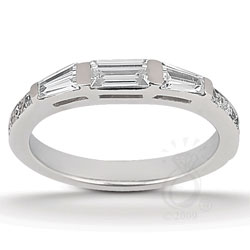
    Baguette setting — A rectangular-shaped stone with rows of step-like facets. If the baguette’s two long sides taper inward, it is called a Tapered baguette. Baguettes in long, thin cut rectangles are often used as enhancements to a lager center stone, or on a watch bezel.

    Bar setting — Similar to the channel setting, it is a circular band of diamonds or gemstones that holds each stone in by a long thin bar, shared between two stones.

    Barion cut — This has a traditional step-cut crown and a modified brilliant-cut pavilion. A square barion cut diamond has 61 facets, excluding the culet.

    Bearding or girdle fringes — The outermost portion of the stone, called the girdle, can develop small cracks that resemble whiskers during the polishing process. The bearding can sometimes be removed, if not too dramatic, with slight re-polishing, and if the weight allows.

    Bezel — With a bezel setting, a rim holds the stone and completely surrounds the gem. It is the upper portion above the girdle of a cut stone. Bezels can have straight edges, scalloped edges, or can be molded into any shape to accommodate the stone. A watch bezel is the upper part of the case surrounding the dial. They can be set with diamonds or other gemstones.

    Blemishes — The term blemish is used when the diamond has scratches or marks on the external area of the stone.

    Brilliance — Liveliness, or sparkle in a stone when light is reflected from the surface and from the total internal reflection of light.

    Brilliant-cut — Brilliant cuts are scientifically found to reflect the most light from within the stone, and often are considered to have the most brilliance of all cuts. A round brilliant-cut diamond has 58 facets. Other brilliant cuts include the heart, oval, marquise and pear shaped.

    Cabochon — A facet-less style of cutting that produces a smooth surface. They can be in many shapes, including round with high domes to squares.

    Carat — Unit of measure of weight of diamonds and gemstones. One carat is equivalent to 200 milligrams. One carat can also be divided into 100 “points.” A .75-carat stone is the same as a 75-point or 3/4-carat stone.

    Certification (or Diamond Grading Reports) — There are many recognized gemological laboratories that can grade your stones for a fee. The most well known is the GIA, Gemological Institute of America.

    Channel setting — Used most frequently for wedding and anniversary bands, a channel setting will set the stones right next to each other with no metal separating them.

    Clarity — A diamond often has natural imperfections, commonly referred to as inclusions, which contribute to its identifying characteristics. Inclusions are found within the diamond, and can be white, black, colorless, or even red or green. Most are undetectable by the human eye, and can only be seen with 10X magnification. Inclusions are ranked on a scale of perfection called clarity.

    Cleavage — A natural area of the diamond where a weak bond holds the atoms together. The gem will be split along these planes by the cutter.

    Cluster setting — This setting surrounds a larger center stone with several smaller stones. It is designed to create a beautiful larger ring from many smaller stones.

    Color — Diamonds are graded on a color scale established by the Gemological Institute of America (GIA). Fancy colors refer to diamonds with hues like pink, blue, green, yellow, and very rarely red. Fancy colors are not included in this color scale and are considered extremely rare.

    Crown — This is the upper portion or the top of a diamond.

    Culet — The bottom point of the diamond. It may be polished in some stones. Sometimes, a cutter may choose to make the culet a surface instead of a point.

    Cushion cut — A mixed-cut diamond shaped like a square pillow.

    Cut — Cut refers to the angles and proportions a skilled craftsman creates in transforming a rough diamond into a polished diamond. Based on scientific formulas, a well-cut diamond will internally reflect light from one mirror-like facet to another and, disperse and reflect it through the top of the stone. This results in a display of brilliance and fire. Diamonds that are cut too deep or too shallow lose or leak light through the side or bottom, resulting in less brilliance, and ultimately value.

    Cutting style — Cutting styles are different than diamond shapes. The simplest and most common way to explain cutting style is to categorize it into the following three basic types: Step-cut, Brilliant-cut and Mixed-cut.

    Deep cut — When a diamond is cut too deep, it will lose or leak light through the side or bottom. This results in less brilliance and value.

    Diamond — A diamond is the hardest known natural substance. It is crystallized carbon. Diamonds are mined in their rough form and then, cut and polished to reveal their brilliance.

    Diamond Grading Reports — There are many recognized gemological laboratories that can grade your diamond for a fee. The most well known is the GIA, Gemological Institute of America.

    Dispersion — When light enters a diamond it reflects off the facets and the angles cut into the stone. This distribution of light is known as dispersion, or the display of the spectral colors.

    Source: Jewelry.com


    A baguette:


    Wedding band with baguette stones (do not eat!)
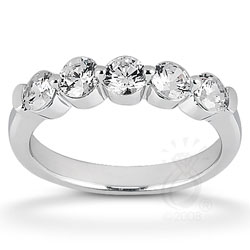
    Style 10151WB

    Wedding Band With Round And Baguette Stones

    Matching wedding band with approximately 2/3ct t.w. round brilliant and baguette stones.

  • Organizing your Jewelry – Simply

    Moissanite, diamonds, silver, gold, rubies, amethysts…all make for gorgeous jewelry. But your jewelry isn’t worth much if it’s tangled up in a knot or you simply can’t find it!

    This article outlines some clever and decorative ways to organize your jewelry so it’s not a jumble!

    Choose one of the following methods to organize your jewelry.

    * Use clear plastic straws. Cut several straws in half, then feed single-strand bracelets (or necklaces) through them, one by one. Make sure a bit of each bracelet is hanging out of either end so that they can still be clasped shut. After fastening them, place the jewelry-filled straws in a drawer or a case so you’ll be able to spot your untangled pieces easily.


    * Pull unused teacups out of your cupboard. Put pretty teacups to decorative use by lining them on your bureau and putting bracelets in each. If you place more than a couple in one, dangle each bracelet over the edge so that they all stay separated.


    * Hang a key holder above your dresser. Declutter your space by draping bracelets over individual key hooks. Your jewelry box will have room for other trinkets, and your wall will be newly adorned.


    * Purchase an affordable jewelry organizer. Many online retailers carry jewelry holders that will prevent chains from becoming a hodgepodge. You can find everything from pouches to stands with decorative hooks. But whatever you buy should be practical, with individual compartments.


    One to try is the Stacking Bracelet & Watch Tray, a storage system with connecting pieces ($12 to $18, containerstore.com) .

    ― Elinor Smith from RealSimple.com

  • Creative Glass Cutting with Diamonds & Moissanite

    I stumbled across this and found it pretty amazing. The video shows the industrial use of diamonds as a way to shape and create beautiful pieces of artwork. In most of these cases, moissanite is used, since it possesses almost exactly the same quality as diamonds for a fraction of the price.

    To see some of our artwork with moissanite, check out our dedicated moissanite page.

    Here’s some of our moissanite artwork (not intended to cut glass unless absolutely necessary)!

    Ring with Moissanite Stone

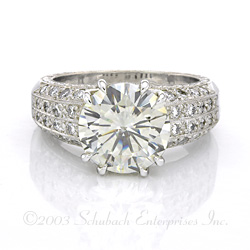
    Round Pave’ Moissanite Ring

    Beautiful hand engraved pave’ diamond or moissanite ring with a round center stone and four rows of pave diamonds weighing approximately .55ct in total. Can accommodate a center stone size of 2ct+ and is shown with a 4ct.

    Center Stone Type: Natural Diamond, Clarity Enhanced Diamond, Gemesis Cultured Diamond, Moissanite, Radiance Diamond Simulant

  • Jewels still Holding their own at Auction

    Auctions seem to exist in a special time and place, where decadence and high bids still reign, despite a daunting economy. According to one expert:

    “Gems and jewels have been doing brilliantly at auction for months, as if bidders had never been told that there is a recession,” Souren Melikian writes.

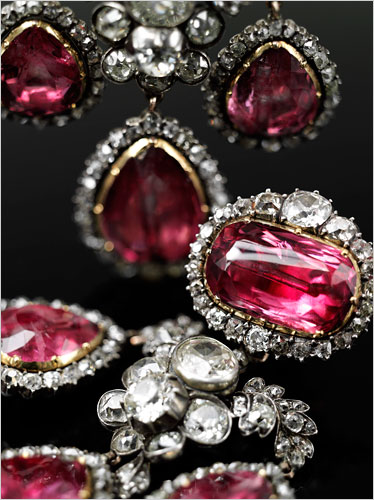
    (above) A late 18th-century pair of ear clips with spinels and diamonds, cataloged as “the property of a German Princely and Liechtenstein Ruling Family,” almost quadrupled the high estimate at $105,000 at Sotheby’s Geneva auction.

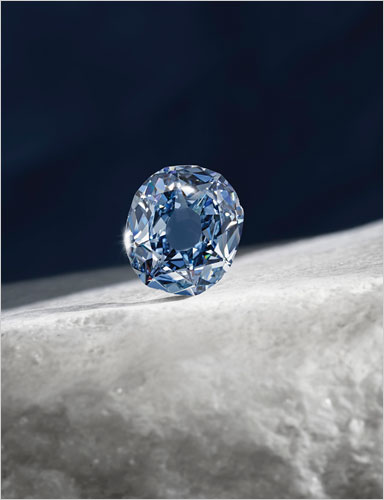
    (above) On Dec. 10, when the mood in London was at an all-time low, Christie’s sold the most expensive jewel ever. The 35.56-carat blue diamond rose to $24.31 million, or to be strictly accurate, £16.39 million, to Laurence Graff of London.

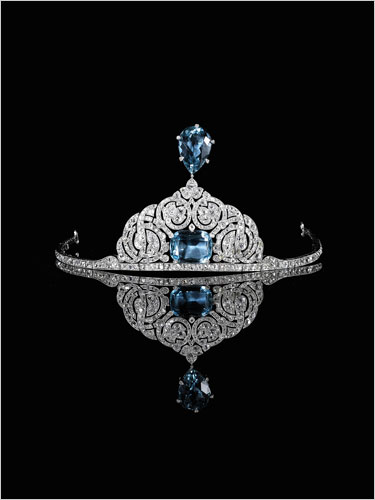
    (above) Where aristocratic provenance could be established, jewels soared sky-high. A diadem and necklace made by Cartier in 1912 for Olga Princess Paley, Countess of Hohenfelsen, both doubled their high estimates. The diadem (described as an “aigrette tiara”) set with rose-cut diamonds and two aquamarines, brought $512,014.

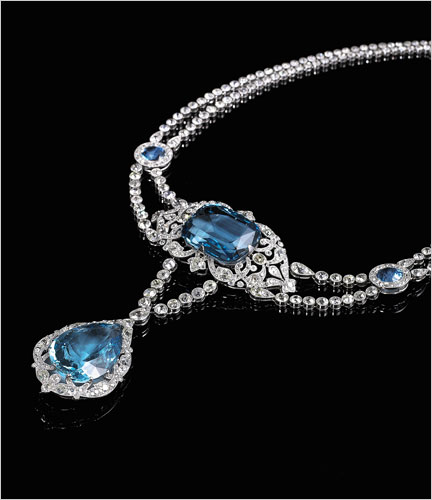
    (above) The necklace, designed in the same heavily ornate style, cost an equally breathtaking $392,700.
    (above) At Christie’s late spring London sale of jewelry on June 10, signed jewels set with good quality stones sold like hot cakes regardless of style or period.

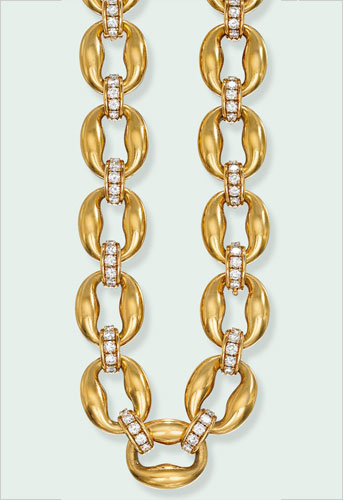
    A necklace made from oval gold links joined by diamond-set clasps and signed Cartier Paris excited bidders, who sent it climbing to $42,750, more than triple the estimate.

    Photo: Sotheby’s

    Source: The New York Times