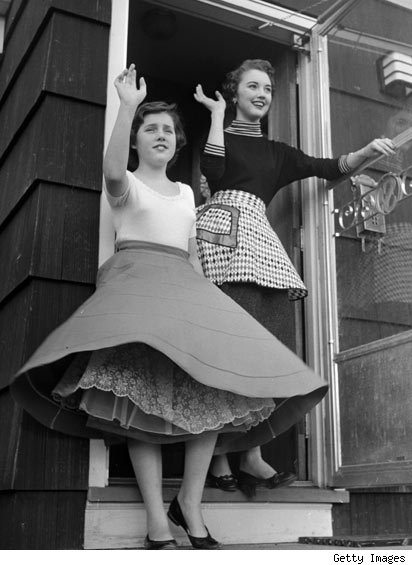
The 1950’s ushered in its own look stylistically. Rhinestones became all the rage, pearls gave that classic touch and glass beads and copper highlighted fun yet conservative fashionwear. If there’s a blast from the past you’d like to re-create, we can custom design a retro jewelry piece to fit today’s look.
1950s Jewelry – After the war was over, Americans returned to making large quantities of costume jewelry. Rhinestone jewelry returned with a vengeance giving rise to many makers of rhinestone studded necklaces, bracelets, rings and brooches.
Pearls were also popular for business and younger women. American efforts to help our former enemies to recover gave rise to much jewelry made in Japan, mostly of pearls and beads. And also jewelry from Western Germany was imported, typically glass beads.
Copper jewelry became popular giving rise to a number of companies based in California, as well as some individual designers such as Gret Barkin on the East Coast. Charm bracelets of silver, expansion rhinestone bracelets, gold-filled lockets were popular, as well as accessories such as rhinestone studded ladies compacts.
There’s nothing worse than having a beautiful collection of jewelry but its either tangled or can’t be found easily. If you’ve invested in jewelry, its certainly worth the investment in time to make sure its stored easily. Take note of these easy steps. Remember: a stich in time prevents necklace entanglement!
* Jewelry should be stored the way that it’s worn to keep it from getting tangled or nicked, and so you can easily see what you have. For example, hanging necklaces and earrings. For creative hanging options, read Creative Jewelry Storage.
* Don’t rest pieces on top of one another or jostle together (especially pieces with delicate details or stone settings). If you must stack for space, simply place a square of good quality, wool felt between each piece to prevent them from rubbing against one another.
* Think about storing silver pieces in small plastic zip top bags. Include an anti-tarnish strip (available for a small cost at jewelry stores) and change out the strip every 6 to 9 months to maintain the silver.
* Keep jewelry out of humid spaces like the bathroom, and areas where the temperature fluctuates.
* Avoid storing in cardboard boxes and keep costume jewelry away from oak to prevent damage from fumes that escape from the wood.
Sitting at the airport, I can’t help but notice jewelry. What do people wear when they’re traveling? What have they brought with them? It got me thinking about some general rules to follow so your trip is stress-free and safe:
Choose pendants that can be easily attached, such as those with a magnetic bail. The magnetic bail makes it a snap (no pun intended) to add and remove the pendant.
Take a brooch that can serve double duty as a pendant when it’s not being used as a pin.
For flexibility, take necklaces and bracelets in a neutral color. Pearls are great for this purpose. They can be worn with almost any color and combined easily with many other necklaces.
Select pieces that complement each other. Look for an element that is common to both such as a specific stone, bead color or style.
Take items that can be easily and efficiently packed. Elasticized cuff bracelets, for example, are great for travel. They’re comfortable, don’t get in the way as you handle luggage, and can be flattened for packing.
Bring a couple of dressy pieces that can be worn in the evening. For instance, replace a more casual pendant with an elegant one to create an evening look.
We all know this feeling: we’ve lost an earring but can’t seem to part ways with that other one. Perhaps its too pretty, or worse, too expensive! This video has some great ideas on what to do with that precious little loner:
I wondered about this over coffee this morning: how long have pierced ears been around? I must not have been fully caffeinated yet because my guess was that it started in the 1960’s! Apparently, I’m a few hundred centuries off.
Pierced ears and earrings for pierced ears have been found on every continent throughout history. Evidence from the earliest civilizations in the Middle East show that pierced ears were worn at least six thousand years ago, but given the popularity of pierced ears in non state-level societies, they certainly must predate the archaeological record. Multiple ear piercings were used in some cultures, such as ancient Mesopotamia, pre-Colombian Meso-America, and the Greco-Roman world. Many cultures have also stretched the ear holes and worn earplugs. Earplugs were worn by ancient Egyptians, Mayans, and Aztecs, by the Chinese, as well as by traditional cultures around the world.
Graduated three stone dangle earrings with approximately 1ct t.w. (dia equiv) Charles and Colvard created round moissanite. Available in 14kt white gold only.
Here at Joseph Schubach Jewelers, we seek to enlighten you. We want to make sure our clients are as informed as possible. Yesterday we were asked what “cabochon” meant.
Definition: A cabochon, often referred to as a cab for short, is a certain cut of stone that is very popular in numerous jewelry designs, especially those that include gemstones. A cab can be made from just about any kind of stone as well as ceramic, porcelain, or even wood. The materials doesn’t matter. The defining elements of a cabochon have more to do with the shape of the component: it is flat on one side and domed or rounded on the other side.
Cabs can come in all kinds of geometric and asymmetrical shapes, but the most important part is the flat side of a cab because that is where it will usually be secured with wire, metal, or even beads.
We’re often asked “Which gem offers me the most value?” There’s no easy answer to that question since gemstones and their corresponding market constantly fluctuate. One thing is for sure: the values of gems go up generally, not down. According to one service that tracked gemstone prices for the last 3 years, prices have risen an average of 20% since 2005. Those that have risen the fastest? Tanzanite and Burmese ruby.
If you were to rate a good gemstone based on superior hardness (greater than 7 on the Mohs scale), durability, good transparency and clarity and depth of color, here’s what one expert considered the best value (or bang for your buck).
Sapphire
Pros: hardness of 9; no cleavage; high refractive index (so excellent brilliance); good dispersion (fire); good choice of colors though blue is the perennial favorite. Cons: usually heat treated Price range: $300-$600+ per carat for heated sapphire; $1000+ per carat for unheated sapphire
Spessartite Garnet
Pros: hardness of 7.5; indistinct cleavage; very high refractive index (higher even than sapphire); always untreated Cons: available only in yellow-orange to orange-red Price range: $75-$150+ per carat
Spinel
Pros: hardness of 8; indistinct cleavage; high refractive index; very good fire; wide choice of colors; always untreated Cons: can be difficult to find, especially in larger sizes Price range: $50-$400+ per carat, depending on size
Tourmaline
Pros: hardness of 7 to 7.5; indistinct cleavage; good brilliance and fire; amazing choice of colors; affordable in large sizes; usually untreated Cons: stones tend to be highly pleochroic or multicolored Price range: $25-$150+ per carat, depending on size; paraiba tourmaline $300 to $1000+ per carat
I can’t tell you how many nights I’ve struggled with putting on a necklace with a tiny clasp and no one around to help me. Sometimes I’ve just ditched wearing jewelry because its too darn time-consuming. Seriously, some jewelers need to design much better (and easier) necklace clasps. Someone sent me this video and while I haven’t tried this additional clasp, it sounds like a time saver…and sanity saver!
The Bahia Emerald is one of the largest emeralds (or more appropriately, emerald crystals embedded in a host rock) and contains the largest single shard ever found. The approximately 840 lb (1,900,000 carats) Brazilian stone narrowly escaped flooding during Hurricane Katrina in 2005 during a period of storage in a warehouse in New Orleans. This short video retells some of the lore of its discovery.
Pyrite is a common mineral that is called several other names, most notably Marcasite and Fools Gold. Pyrite is also a Greek word that means fire (for obvious reasons); it’s a beautiful mineral and resembles gold with its sparkle and luster.
It’s also appearing in a number of indie jewelry designers’ collections, such as Jamie Joseph, Melissa Joy Manning and Robindira Unsworth. Pyrite pairs nicely with this Fall’s 2012 fashions and is affordable.